
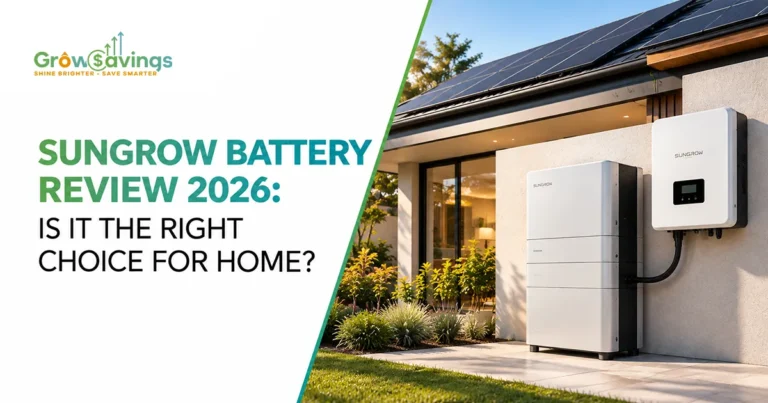
The Sungrow Battery Review 2026 shows that Sungrow is a strong option for Australian homeowners seeking reliable, expandable solar energy storage. Its SBR and SBH batteries offer lithium iron phosphate technology, flexible capacities and a 10-year warranty. However, the best choice depends on household electricity usage, inverter compatibility and installation costs.
Sungrow batteries help households store excess solar electricity for evening use. They can also provide backup power when paired with suitable equipment.
This review explores their features, Australian prices, performance and potential drawbacks to help you make an informed decision.
Sungrow Battery Review 2026: Key Features at a Glance
Sungrow offers two main high-voltage residential battery ranges in Australia: SBR and SBH.
Both use lithium iron phosphate (LFP) chemistry, known for thermal stability and long cycle life.
| Feature | Sungrow battery details |
| Battery technology | Lithium iron phosphate (LFP) |
| SBR storage capacity | 6.4–25.6kWh |
| SBH storage capacity | 10–40kWh |
| Modular design | Yes |
| Usable capacity | Up to 100% depth of discharge |
| Monitoring | Sungrow iSolarCloud |
| Warranty | 10 years |
| Backup power | With compatible hybrid inverter |
These batteries use stackable modules, allowing homeowners to choose storage capacity based on their electricity requirements.
Unlike all-in-one battery systems, Sungrow batteries require a separate compatible hybrid inverter.
Sungrow SBR vs SBH Battery: What’s the Difference?
The main difference between Sungrow SBR and SBH batteries is their module capacity and power capability.
Sungrow SBR Battery
The SBR range uses 3.2kWh battery modules, with configurations starting at 6.4kWh.
For example, an SBR096 provides 9.6kWh of usable storage. This capacity may suit households with moderate evening electricity consumption.
Its modular design also allows homeowners to increase storage capacity, subject to compatibility and installation requirements.
Sungrow SBH Battery
The SBH range uses larger 5kWh modules and supports configurations up to 40kWh.
Its higher power capability makes it suitable for households with larger electricity loads or greater backup requirements.
For example, a household running multiple air conditioners and other appliances may benefit from an appropriately sized SBH system.
However, homeowners should check inverter compatibility before selecting either battery.
How Much Does a Sungrow Battery Cost in Australia?
Sungrow battery prices vary by storage capacity, inverter requirements, installation complexity and government incentives.
In 2026, indicative Australian installed prices for common SBR configurations are:
| Sungrow model | Usable capacity | Estimated installed price |
| SBR096 | 9.6kWh | $5,800–$8,000 |
| SBR128 | 12.8kWh | $6,600–$9,400 |
| SBR160 | 16kWh | $7,700–$10,000 |
Indicative Australian market estimates after applicable federal battery incentives. A new hybrid inverter or additional electrical work may cost extra.
Eligible Sungrow batteries may qualify for discounts through Australia’s Cheaper Home Batteries Program.
Therefore, homeowners should request quotes showing equipment, installation and government incentives separately.
Sungrow Battery Performance and Efficiency
Sungrow batteries use LFP cells, which offer good thermal stability and long-term energy storage performance.
Their modular design also helps homeowners match storage capacity with daily electricity consumption.
For example, a household using 8kWh overnight could consider a 9.6kWh battery.
However, actual available energy depends on system settings, conversion losses and reserved backup capacity.
The iSolarCloud monitoring platform allows homeowners to track solar generation, battery charging and electricity consumption.
This information can help households understand energy usage and improve solar self-consumption.
Can a Sungrow Battery Power Your Home During a Blackout?
Yes, Sungrow batteries can provide backup electricity during grid outages when installed with compatible backup-capable equipment.
However, the battery alone does not guarantee whole-home backup.
Backup performance depends on inverter output, electrical configuration and connected appliance loads.
For example, a properly configured system may support essential circuits such as lighting, refrigeration and internet equipment.
Running high-power appliances simultaneously may require a larger inverter and battery configuration.
Homeowners should discuss backup requirements with their installer before purchasing.
Sungrow Battery Warranty and Lifespan
Sungrow provides a 10-year limited warranty for eligible SBR and SBH batteries in Australia.
Its performance warranty generally guarantees at least 70% of initial capacity within the specified warranty period.
However, coverage depends on operating conditions, installation requirements and applicable warranty terms.
For example, the current Australian warranty includes temperature-related conditions that may affect performance coverage.
Sungrow Australia and New Zealand Service
A battery may continue operating beyond ten years, although its storage capacity will gradually decline.
Correct installation, monitoring and suitable operating temperatures can support long-term performance.
Sungrow Battery Review: Pros and Cons
| Advantages | Limitations |
| Flexible modular storage capacities | Requires a compatible hybrid inverter |
| LFP battery technology | Inverter upgrades may increase costs |
| 10-year limited warranty | Backup capability depends on configuration |
| Suitable for different household sizes | Larger battery stacks require more space |
| Remote monitoring through iSolarCloud | Warranty coverage has conditions |
Sungrow offers a practical balance between storage flexibility and functionality.
However, homeowners should evaluate the complete installed system rather than comparing battery prices alone.
Is a Sungrow Battery Worth Buying in 2026?
Yes, a Sungrow battery can be worth buying in 2026, particularly for households with existing solar panels and substantial evening electricity consumption.
Homeowners who already have a compatible Sungrow hybrid inverter may find installation more straightforward.
However, financial savings depend on electricity tariffs, solar generation and battery usage.
For example, shifting 8kWh of solar electricity into evening consumption could avoid $2.40 in grid purchases at $0.30/kWh.
Actual net savings would be lower after accounting for conversion losses and forgone solar export payments.
Therefore, compare estimated annual savings against the final installed price before making a decision.
Conclusion
This Sungrow Battery Review finds that Sungrow is a worthwhile option for Australian homeowners seeking expandable solar storage and dependable everyday performance.
The SBR range suits many standard households, while the SBH range offers greater storage and power flexibility.
However, the right choice depends on electricity consumption, inverter compatibility, backup requirements and total installation costs.
Considering a Sungrow battery for your home? Contact Grow Savings Pty Ltd for a personalised solar battery assessment and quote. Find a storage solution suited to your household’s energy needs.
Frequently Asked Questions
1. Is Sungrow a good solar battery brand?
Yes. Sungrow offers modular LFP batteries, monitoring features and a 10-year limited warranty. Suitability depends on household requirements and installation quality.
2. How much does a Sungrow battery cost in Australia?
A 9.6kWh Sungrow SBR battery may cost approximately $5,800–$8,000 installed after applicable incentives. Additional inverter costs may apply.
3. Can I add a Sungrow battery to existing solar panels?
Yes, provided the system uses or can be upgraded to compatible equipment. An installer must assess the existing inverter and electrical configuration.
4. How long does a Sungrow solar battery last?
Sungrow provides a 10-year limited warranty for eligible models. Actual lifespan depends on usage, operating conditions and maintenance.