
If you have solar panels in Victoria, you are probably earning credits on your electricity bill for the power you send back to the grid. That payment is called the Solar Feed-In Tariff Victoria and in 2026, it looks very different from what it was just a few years ago.
Feed-in tariffs have dropped significantly. The rules changed on 1 July 2025. Many Victorian solar owners do not yet know what this means for their bills.
This guide explains exactly how the Solar Feed-In Tariff Victoria works today. You will also find current rates by retailer, the best strategies to earn more, and a clear answer to whether solar is still worth it despite lower export payments.
What Is the Solar Feed-In Tariff and How Does It Work?
A solar feed-in tariff (FiT) is a payment your electricity retailer makes to you. You receive it for every kilowatt-hour (kWh) of surplus solar electricity your panels send to the grid.
Here is how it works in practice. Your solar system powers your home first. Whatever is left over – surplus generation – is exported to the grid. Your retailer then credits that exported energy on your electricity bill, measured in cents per kWh.
The credit appears as a reduction on your bill. In some cases, it can offset your daily supply charge. However, it rarely eliminates your electricity bill entirely on its own. The Solar Feed-In Tariff Victoria applies to all residential and small business solar system owners who are connected to the grid across the state – from Melbourne’s eastern suburbs to regional Victoria.
What Changed on 1 July 2025? The Big Shift You Need to Know
This is the most important update for Victorian solar owners in recent years. Therefore, it is worth reading carefully.
Before 1 July 2025, Victoria’s Essential Services Commission (ESC) set a mandatory minimum feed-in tariff each year. Retailers had to pay at least that minimum rate to all solar customers. For 2024-25, that minimum was 3.3 cents per kWh.
From 1 July 2025, the Victorian Government deregulated the Solar Feed-In Tariff, removing the government-mandated minimum rate. Retailers now set their own rates entirely. The only rule is that they cannot pay below zero cents per kWh.
The Victorian Government stated that deregulation was expected to enable solar customers to access a greater range of more flexible feed-in tariffs, while maintaining consumer protections.
However, the practical effect has been mixed. Many retailers have reduced their standard rates. Others have introduced time-varying tariffs that pay more during peak demand hours. Shopping around now matters far more than it did before.
Also important: the average Victorian minimum feed-in tariff rate for the 2025/26 financial year is 1.1 cents per kWh. That is significantly lower than previous years.
How Much Are Feed-In Tariff Rates in Victoria Right Now?
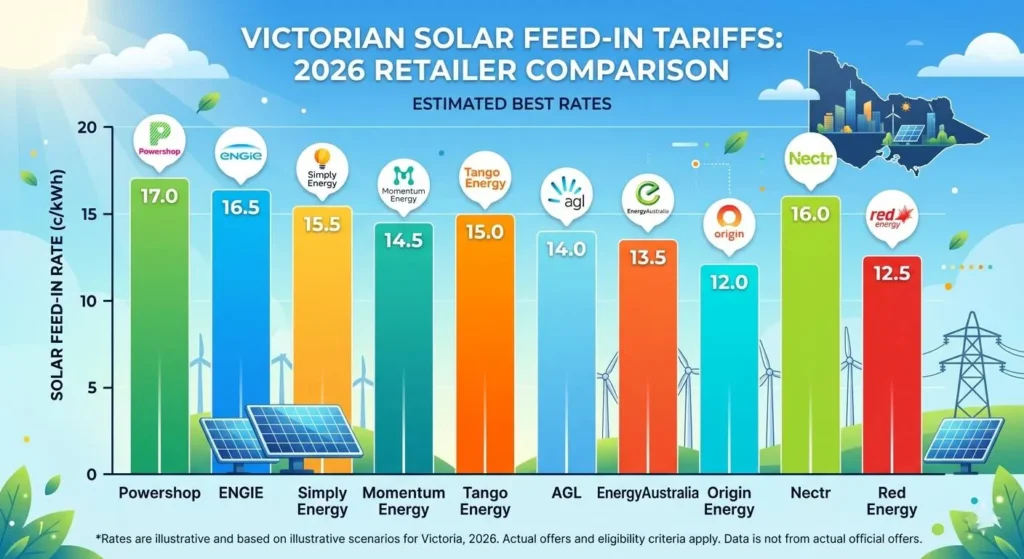
At the time of publishing in 2026, feed-in tariff rates across Victorian retailers vary considerably. The table below shows the current range available to Melbourne and Victorian solar owners.
| Retailer | Minimum FiT Rate | Maximum FiT Rate | Conditions |
| Flow Power | Variable | Up to 45c/kWh | Wholesale spot price – can go negative |
| ENGIE | ~3c/kWh | Up to 11c/kWh | Best rate on first 8–10 kWh/day |
| Origin Energy | ~2c/kWh | Up to 10c/kWh | Time-varying plan available |
| AGL | ~2c/kWh | Up to 8c/kWh | Conditions apply |
| EnergyAustralia | ~2c/kWh | Up to 8c/kWh | Limited to first 10 kWh/day |
| Alinta Energy | ~1c/kWh | Up to 7c/kWh | Plan-dependent |
| Energy Locals | ~1.5c/kWh | Up to 12c/kWh (4pm–9pm) | Time-varying tariff |
Rates are indicative as of March 2026 and are subject to change. Always confirm directly with your retailer before switching plans.
Flow Power currently offers the highest maximum feed-in tariff in Victoria at up to 45 cents per kWh, followed by Origin, Alinta Energy, EnergyAustralia and AGL at up to 10 cents per kWh. However, Flow Power’s rate follows wholesale spot prices, which can sometimes go negative, meaning you could be charged for exporting.
ENGIE provides the highest maximum feed-in tariff among standard retail plans at 11 cents per kWh. EnergyAustralia and AGL both offer up to 8 cents per kWh.
Also note that maximum rates often apply only to the first 8-10 kWh exported per day. Exports beyond that cap receive the standard lower rate.
Flat vs Time-Varying Feed-In Tariff Victoria: Which One Pays More?
Victorian solar owners currently have a choice between two types of feed-in tariff structures.
Flat (Single Rate) Feed-In Tariff
A flat feed-in tariff pays the same rate no matter what time of day you export. For example, 5 cents per kWh at 10 am pays the same as 5 cents per kWh at 6 pm. This structure is simple and predictable. However, it does not reward you for exporting at high-demand times.
Time-Varying Feed-In Tariff
A time-varying tariff pays different rates depending on when you export. For example, Energy Locals currently offers 1.5 cents from 10 am to 2 pm, 2.8 cents from 2 pm to 4 pm, and up to 12 cents from 4 pm to 9 pm.
Therefore, households with west-facing panels – which generate more electricity in the late afternoon – can benefit significantly from a time-varying structure. Similarly, households with battery storage can discharge to the grid during peak evening hours to earn the higher rate.
The key question to ask yourself is: when does my system export most of its electricity? If your panels face north and generate the bulk of their output between 10 am and 2 pm, a flat rate plan may actually serve you better than a time-varying one with very low midday rates.
Also Read: How Much Is the Solar Battery Rebate in Victoria 2026?
Why Have Solar Feed-In Tariff Rates Dropped So Much in Victoria?
This is a question many Victorian solar owners ask. The short answer is: Solar has been too successful.
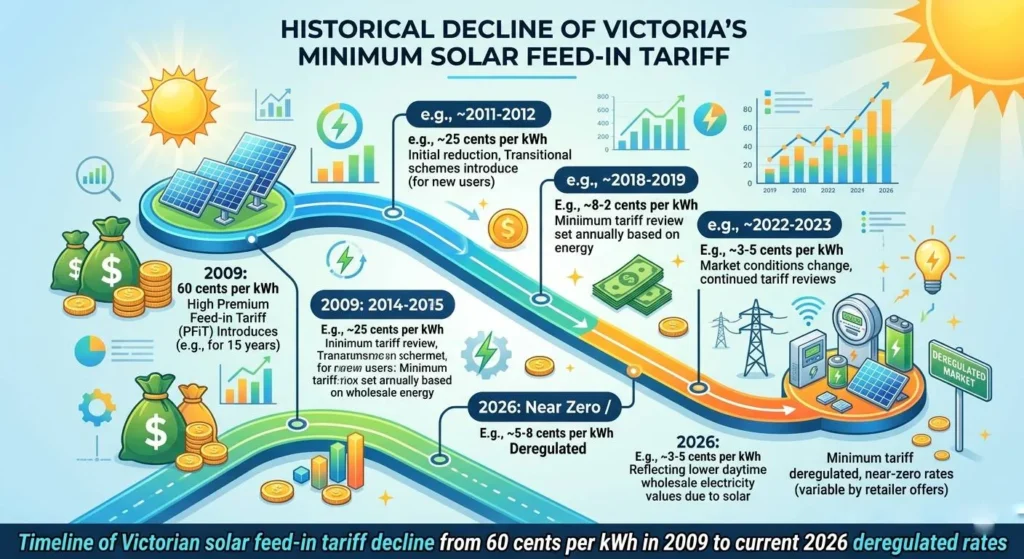
The flat minimum feed-in tariff for 2025-26 was lower than for 2024-25, mainly due to lower daytime wholesale electricity prices. The increased number of households with rooftop solar reduced demand and increased supply, driving down wholesale electricity prices, especially during daylight hours when most solar exports occur.
In simple terms, everyone’s solar panels export at the same time – between roughly 10 am and 2 pm. This floods the grid with cheap electricity. When supply is high and demand is low, the wholesale price of electricity drops. Retailers therefore pay less for what you export, because they can buy power from the grid more cheaply at that time.
Australia now has over 4.22 million solar PV installations. That level of adoption creates a predictable pattern: huge solar supply hits the grid at the same time, pushing wholesale electricity prices down. When wholesale prices are low, the market value of exported solar is low, and feed-in credits follow.
However, this does not mean solar has become less valuable. It means the value has shifted – from export income to self-consumption savings.
Self-Consumption vs Export: Where the Real Solar Savings Come From
This is the most important concept for every Victorian solar owner to understand in 2026.
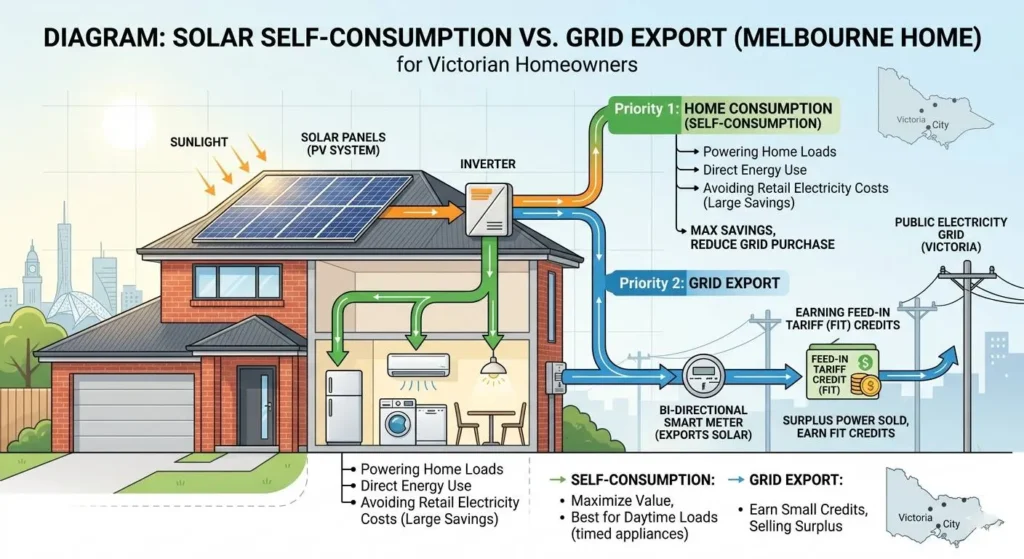
Customers avoid retail tariffs by self-consuming the electricity they generate. For a customer on the Victorian Default Offer in 2024-25, the retail price ranged from approximately 26 to 35 cents per kilowatt-hour, depending on their distribution zone.
Compare that to the feed-in tariff: 1 to 11 cents per kWh for exports. The difference is stark.
Every unit of solar electricity you use directly in your home saves you the full retail rate – up to 35 cents per kWh. Every unit you export earns you just 5 to 11 cents per kWh at best.
That means self-consuming one kWh of solar is worth three to five times more than exporting the same kWh.
Also, this changes how you should think about system size. A larger system that generates more than you can use during the day provides diminishing returns through export income alone. However, pair it with battery storage – and that surplus becomes stored savings rather than cheaply exported electricity.
How to Maximise What You Earn From Your Solar Feed-In Tariff
Even with lower rates, there are clear strategies Victorian solar owners can use to extract more value from their feed-in tariff. Here is what actually works in 2026.
Shift Appliances to Daytime Hours
Run your power-hungry appliances – washing machines, dishwasher, water heater – during the middle of the day to avoid retail prices. This reduces how much you export at low rates and increases how much you self-consume at high-value retail rates.
Most modern appliances have built-in delay timers. Set your washing machine to start at 10 am and your dishwasher to run at noon. This single habit change can add $200 to $400 to your annual solar savings.
Switch to a Plan With a Better Feed-In Rate
Not all retailers pay the same rate. Also, some plans offer higher feed-in tariffs on the first 10 kWh of daily exports. If your system regularly exports in that range, a tiered plan can significantly improve your credits.
However, always compare the full plan. A higher feed-in tariff sometimes comes with a higher import rate. Therefore, calculate the total bill impact – not just the export credit.
Consider a Time-Varying Feed-In Tariff if You Have West-Facing Panels or a Battery
If your panels face west and export strongly after 3 pm, a time-varying plan could pay you 8 to 12 cents per kWh during that window – considerably more than a flat rate plan.
Battery owners can take this further by storing solar surplus during the day and discharging to the grid during peak evening hours to earn the premium time-varying rate.
Review Your Plan Annually
Maximum rates may only be offered for the first 12 months after initial sign-up. Therefore, set a calendar reminder to review your electricity plan every 12 months and compare whether a better feed-in tariff structure is available.
Should a High Feed-In Tariff Be Your Only Reason to Switch Retailers?
No – and this is a common mistake Victorian solar owners make.
A plan advertising 11 cents per kWh feed-in tariff sounds attractive. However, it may also charge you 38 to 42 cents per kWh for electricity you import from the grid in the evening.
Plans with big feed-in tariffs often come with bigger usage and supply charges. To find the best deal, consider the usage rates and supply charges alongside the feed-in tariff.
The right measure is your total electricity bill – not just the export credit line. Always run a full comparison using your actual consumption and solar generation data before switching retailers. Victoria’s energy comparison tools allow you to enter your solar export data alongside your import usage to calculate the true bill impact of each plan.
How Does Adding a Battery Change Your Feed-In Tariff Strategy?
Adding a battery fundamentally changes how you interact with the Solar Feed-In Tariff Victoria market – and generally for the better.
Without a battery, your system exports surplus solar during the middle of the day when feed-in rates are lowest. With a battery, you store that surplus instead. You then use it in the evening when grid electricity is most expensive, saving the full retail rate rather than earning a few cents per kWh from export.
For households on time-varying feed-in tariff plans, batteries also create an opportunity to discharge to the grid during evening peak hours – when rates like Energy Locals’ 12 cents per kWh apply from 4 pm to 9 pm. This strategy is sometimes called “arbitrage” and is growing in popularity among Melbourne battery owners.
The federal Cheaper Home Batteries Program, launched on 1 July 2025, provides approximately 30% off eligible battery installations – around $3,110 off a 10 kWh battery before the May 2026 rate reduction. This makes adding a battery in 2026 more financially accessible than ever for Victorian households.
Is Solar Still Worth It in Victoria With Low Feed-In Tariffs?
Yes – but the strategy has shifted.
Solar remains financially strong in Victoria when systems are optimised for self-consumption, especially with the rapid increases in power prices.
Consider a Melbourne household with a 6.6kW system, 40% self-consumption, and a retail import rate of 32 cents per kWh. Their annual savings from self-consuming solar alone are approximately $1,283. Feed-in income adds a further $200 to $400, depending on the retailer and export volume. Total annual savings: approximately $1,500 to $1,700 – on a system that costs around $4,400 to $4,600 after all rebates.
That is a payback period of roughly three to four years, after which the system generates effectively free electricity for the remaining 20-plus years of its life. For households that can shift their energy use to daylight hours, the payback is often driven by savings, not the feed-in tariff.
The feed-in tariff is no longer the primary financial justification for solar in Victoria. Self-consumption is. However, export income still adds meaningful value – particularly for homeowners who choose the right retailer plan, use a time-varying tariff effectively, or add battery storage to maximise the value of every kWh their panels generate.
Conclusion
Understanding your Solar Feed-In Tariff Victoria, is just one piece of the solar savings puzzle. The real financial wins in 2026 come from self-consumption, the right system size, quality installation, and maximising every government rebate available before they reduce further.
At Grow Savings, our CEC-certified team helps Melbourne and Victorian homeowners navigate all of it – from choosing the right solar system and battery to ensuring you are on the best retailer plan to maximise your feed-in credits. We offer a free energy audit to assess your property’s specific situation and give you honest, no-pressure advice on the best path forward.
Book your free solar audit with Grow Savings today
Frequently Asked Questions
What is the solar feed-in tariff in Victoria in 2026?
From 1 July 2025, Victoria no longer has a government-mandated minimum feed-in tariff. Retailers set their own rates, which cannot go below zero cents per kWh. In 2026, standard flat feed-in tariff rates range from approximately 1 to 11 cents per kWh, depending on the retailer. Time-varying plans can pay up to 12 cents per kWh during peak evening hours.
What is the best solar feed-in tariff in Victoria in 2026?
Based on current data, ENGIE offers the highest standard plan rate at up to 11 cents per kWh, typically applied to the first 8 to 10 kWh of daily exports. Flow Power offers up to 45 cents per kWh on a wholesale spot price plan, but rates can also go negative. For households on standard plans, ENGIE, Origin, and AGL are currently the strongest options.
How does the solar feed-in tariff work in Victoria?
Your solar panels power your home first. Any surplus electricity is exported to the grid. Your electricity retailer credits this export at a rate in cents per kWh, shown as a deduction on your electricity bill. The rate depends on your plan – either a flat rate applied at all times, or a time-varying rate that pays more during peak demand hours.
Why has the feed-in tariff in Victoria dropped so much?
The primary driver is the growth of rooftop solar itself. With over 787,000 solar systems in Victoria, huge amounts of solar electricity flood the grid simultaneously during the middle of the day, pushing wholesale electricity prices to near zero during daylight hours. Retailers, therefore, pay very little for exported solar because they can source power from the wholesale market cheaply at those times.
What was Victoria’s premium feed-in tariff?
Victoria’s Premium Feed-In Tariff was introduced in November 2009, offering 60 cents per kWh. It closed to new applicants in December 2011, and the last premium tariff customers transitioned off the scheme in November 2024. It is no longer available to any Victorian solar owner.
Is it better to use solar or export it in Victoria?
Using solar directly in your home is significantly more valuable than exporting it. Every kWh of solar you self-consume saves you the full retail rate of 26 to 35 cents per kWh. Every kWh you export earns you just 1 to 11 cents per kWh. Self-consumption is worth three to five times more than exporting in Victoria’s current market.
Does a higher feed-in tariff always mean a better plan?
No. Plans with higher feed-in tariffs often charge higher import rates for electricity you buy from the grid. Always compare the total bill impact – including both import rates and supply charges – rather than focusing on the feed-in tariff alone.
Should I add a battery to improve my feed-in tariff earnings?
A battery allows you to store solar surplus rather than exporting it cheaply during the day. You can then use it in the evening when grid electricity is most expensive, or discharge to the grid during peak hours to earn higher time-varying feed-in rates. The federal Cheaper Home Batteries Program now provides approximately 30% off eligible batteries, making this option more accessible than ever.
Disclaimer: Feed-in tariff rates are current as of March 2026 and are subject to change at any time. Always confirm current rates directly with your electricity retailer before switching plans. Grow Savings does not endorse any specific electricity retailer.