
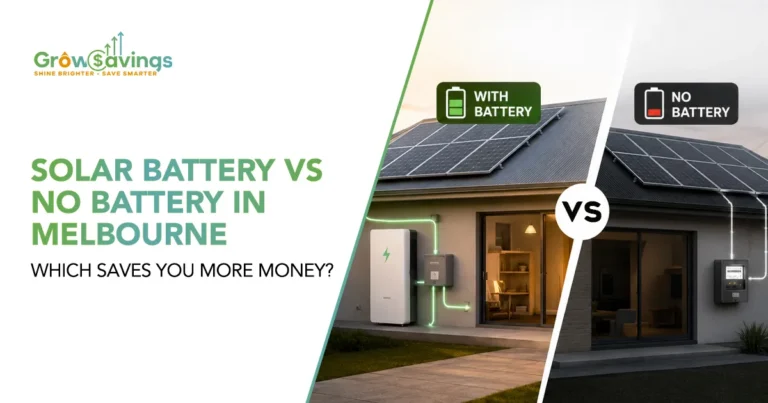
A solar battery in Melbourne saves most households between $800 and $2,000 per year more than a solar-only system- and in 2026, the federal Cheaper Home Batteries Program has reduced upfront battery costs significantly, making storage a financially sound choice for far more Melbourne homes than ever before.
However, a battery is not the right answer for every household. Whether adding storage to your solar system actually makes financial sense depends on when your family uses electricity, how much you currently export to the grid and how much you pay for power after dark.
In this guide, Grow Savings compares the real numbers for Melbourne households- with and without battery storage- so you can make a confident, informed decision about your own home.
Grow Savings is a proudly Australian-owned solar company based in Carrum Downs, Melbourne. As a Clean Energy Council Member and New Energy Tech Approved Seller under the NETCC, we provide transparent, tailored advice to homeowners across Melbourne, Regional Victoria, Sydney, Adelaide and the Sunshine Coast.
Solar Battery in Melbourne: The Short Answer
For most Melbourne families who use the majority of their electricity in the evening, a solar battery is worth it in 2026. The combination of falling battery prices, the federal rebate and Victoria’s low feed-in tariff has fundamentally shifted the financial case for storage.
Without a battery, a typical Melbourne home with a 6.6kW solar system exports a significant portion of its daytime solar generation to the grid at just 4 to 6 cents per kilowatt-hour. With a battery, that same energy is stored and used at night- avoiding grid electricity that costs 32 to 45 cents per kilowatt-hour.
That difference- earning 5 cents versus saving 38 cents for every kilowatt-hour- is the core financial engine behind why solar batteries are now genuinely attractive for Melbourne households in 2026.
How Does Solar Work Without a Battery in Melbourne?
A standard solar-only system works simply. Your solar panels generate electricity during daylight hours. Your home uses whatever it needs in real time- running the fridge, air conditioning, lighting and any appliances you have on during the day. Any electricity your panels produce beyond what your home needs at that moment is automatically exported to the grid.
This is called a grid-connected solar system with no storage. It is the most common setup across Melbourne homes today and it absolutely saves money- particularly for households that use significant electricity during the day.
What Happens to Unused Solar Energy Without a Battery?
Without a battery, unused solar energy flows back to the electricity grid through your smart meter. Your energy retailer pays you a feed-in tariff for each kilowatt-hour exported. In 2026, Melbourne feed-in tariffs sit at 4 to 6 cents per kilowatt-hour for most residential customers.
This means that for every kilowatt-hour of solar energy your home does not use during the day, you earn approximately 5 cents. However, every kilowatt-hour you then draw from the grid after dark costs you 32 to 45 cents. The maths is straightforward- exporting solar energy and then buying it back is a financially poor trade for most households.
Without storage, Solar Victoria data shows that a typical Melbourne home with solar panels self-consumes approximately 25 to 35 percent of the energy their system generates. The remaining 65 to 75 percent is exported at those low feed-in tariff rates.
Melbourne’s Feed-In Tariff in 2026: Is It Still Worth Exporting?
Victoria’s minimum feed-in tariff rate for 2026-27 has been set at 4.9 cents per kilowatt-hour by the Essential Services Commission. Some retailers offer a slightly higher rate- up to 6 to 8 cents per kilowatt-hour- through competitive market offers. However, these rates have fallen significantly compared to the premium feed-in tariffs available in previous years.
For context, Melbourne households on standard tariffs pay between 32 and 45 cents per kilowatt-hour for electricity drawn from the grid. The gap between what you earn from exporting solar energy and what you pay to import grid electricity is now so wide that storing solar energy in a battery- rather than exporting it- is the smarter financial choice for most evening-heavy households.
How Does a Solar Battery Change the Equation?
Adding a solar battery to your Melbourne home changes the way your solar system works in a fundamental way. Rather than sending excess daytime solar generation to the grid at 5 cents per kilowatt-hour, your battery captures that energy and stores it. Your home then draws from the battery first when the sun goes down- before touching expensive grid electricity.
This is called increasing your solar self-consumption rate. With a well-sized battery, Melbourne homes can increase their self-consumption from 25 to 35 percent (solar only) to 60 to 80 percent (solar plus battery). Every percentage point of improvement means more of your own free solar energy powers your home- and less expensive grid electricity does.
What Does a Solar Battery Actually Do?
A solar battery is a lithium iron phosphate (LiFePO4) energy storage system that connects to your solar inverter or operates as part of a hybrid inverter setup. During daylight hours when your panels are producing more electricity than your home is consuming, the surplus energy charges the battery instead of being exported to the grid.
When the sun sets and your solar panels stop generating, your home automatically switches to drawing electricity from the battery. The transition is seamless- you do not notice it happening. Only once the battery is fully depleted does your home draw from the grid. Modern batteries also include smartphone monitoring apps, so you can track your solar generation, battery charge level and grid usage in real time.
How Much Solar Energy Can a Battery Store?
Battery capacity is measured in kilowatt-hours (kWh). The right capacity for your Melbourne home depends on how much electricity you use after dark. A typical Melbourne family of four uses approximately 10 to 15 kWh of electricity between 6pm and 11pm- which is the peak window that a battery is designed to cover.
| Battery Capacity | Typical Evening Coverage | Best Suited For |
| 5 to 7 kWh | 3 to 5 hours of evening use | 1 to 2 person households with low usage |
| 10 kWh | 5 to 8 hours of evening use | Average Melbourne family (3 to 4 people) |
| 13 to 14 kWh | Full evening + overnight | Larger families or high-usage households |
| 15 to 20 kWh | All evening, overnight & early morning | Homes with EV, pool or heavy AC use |
Battery coverage estimates are based on Melbourne average household evening consumption. Your actual coverage will depend on your specific usage pattern and appliance load.
Solar Battery vs No Battery: Real Numbers for Melbourne Homes
To make this comparison concrete and useful, here are three real household scenarios based on typical Melbourne homes in 2026. Each scenario uses a 6.6kW solar system, Melbourne’s average electricity tariff of 35 cents per kilowatt-hour and a feed-in tariff of 5 cents per kilowatt-hour.
Household Scenario 1- Daytime Users (Work From Home)
The household: A couple working from home in Frankston. Daily usage is 18 kWh, with approximately 12 kWh consumed during daylight hours. They run the dishwasher, washing machine and air conditioning during the day.
Without a battery: Their 6.6kW system generates around 24 kWh on an average Melbourne day. They self-consume 12 kWh directly and export the remaining 12 kWh at 5 cents per kilowatt-hour, earning 60 cents. They draw 6 kWh from the grid in the evening at 35 cents, paying $2.10. Net daily grid cost: $1.50. Annual grid savings from solar: approximately $1,600.
With a 10 kWh battery: The 12 kWh of previously exported solar energy now charges the battery. They cover their 6 kWh of evening usage from the battery entirely and export the remaining 6 kWh at 5 cents per kilowatt-hour. Their net daily grid cost drops to near zero. Annual savings increase to approximately $2,000- an improvement of around $400 per year.
Verdict for Scenario 1: For high daytime users, solar-only already performs well. A battery adds moderate value- roughly $400 per year extra- but the payback period is longer than for evening-heavy homes.
Household Scenario 2- Evening Users (Working Families)
The household: A family of four in Cranbourne. Both parents work full-time and the children are at school during the day. Daily usage is 24 kWh, with only 6 kWh consumed during daylight hours. Most electricity use- cooking, TV, heating and cooling- happens between 5pm and 10pm.
Without a battery: Their 6.6kW system generates 24 kWh but the family only uses 6 kWh during the day. They export 18 kWh at 5 cents, earning 90 cents. They draw 18 kWh from the grid in the evening at 35 cents, paying $6.30. Net daily grid cost: $5.40. Annual grid savings from solar: only approximately $600- very poor return on their solar investment.
With a 13 kWh battery: The battery stores 13 kWh of the previously exported solar energy. They cover 13 kWh of their 18 kWh evening usage from the battery and draw only 5 kWh from the grid at 35 cents, paying $1.75 per day. They still export 5 kWh at 5 cents. Net daily grid cost drops to approximately $1.50. Annual savings jump to approximately $2,100- an improvement of $1,500 per year compared to solar only.
Verdict for Scenario 2: This is where a solar battery delivers its strongest financial case. Evening-heavy households see dramatic improvements in annual savings. A 13 kWh battery pays back in approximately 6 to 8 years after the federal rebate– well within the battery’s 10 to 15 year lifespan.
Household Scenario 3- Large Homes with EV or Pool
The household: A family of five in Langwarrin with a ducted reverse cycle system, a swimming pool pump and an electric vehicle charged overnight. Daily usage is 45 kWh- significantly above the Melbourne average.
Without a battery: A 10kW solar system generates approximately 36 kWh per average Melbourne day. Even with daytime appliance use absorbing 15 kWh directly, they still import 24 kWh from the grid in the evenings and overnight for EV charging. Annual grid costs remain high despite having solar.
With a 20 kWh battery: The battery stores enough to cover most evening usage and overnight EV charging. The household self-consumption rate jumps from approximately 30 percent to over 70 percent. Annual savings increase by $2,500 to $3,500 compared to solar only- one of the strongest possible returns on battery storage in Melbourne.
Verdict for Scenario 3: Large households with EVs, pools or heavy air conditioning are the biggest winners from battery storage. The upfront cost of a larger battery is higher, but the annual savings justify it- often achieving payback in under 7 years.
How Much Does a Solar Battery Cost in Melbourne in 2026?
Battery prices in Melbourne have fallen significantly in 2026, driven by the federal Cheaper Home Batteries Program and increased market competition. After applying the federal rebate, typical solar battery costs in Melbourne are as follows.
| Battery Size | Installed Cost Before Rebate | Federal Rebate (Approx.) | Net Cost After Rebate | Best For |
| 5 to 7 kWh | $6,000 to $8,500 | $1,650 to $2,310 | $4,350 to $6,190 | 1 to 2 person homes |
| 10 kWh | $8,000 to $12,000 | $3,300 | $4,700 to $8,700 | Average Melbourne family |
| 13 to 14 kWh | $10,000 to $14,000 | $4,290 to $4,620 | $5,710 to $9,380 | Larger families |
| 15 to 20 kWh | $14,000 to $20,000 | $4,950 to $6,600 | $9,050 to $13,400 | EV owners, large homes |
All prices are indicative and include GST and standard installation. Federal rebate is based on approximately $330 per usable kWh under the Cheaper Home Batteries Program. Actual rebate amounts depend on battery model and current program terms. Contact Grow Savings for an exact quote for your Melbourne property.
When you install a battery at the same time as a new solar system, you can also reduce installation costs compared to retrofitting a battery to an existing system. Adding a battery to a brand-new Grow Savings solar installation is therefore the most cost-effective approach for Melbourne homeowners who are planning to go solar in 2026.
Solar Battery Payback Period in Melbourne: What to Expect
The payback period for a solar battery in Melbourne depends on three key factors: how much electricity you use in the evening, your grid electricity tariff rate and the upfront battery cost after rebates.
In 2026, most Melbourne households see battery payback periods in the following ranges after applying the federal Cheaper Home Batteries Program rebate.
| Household Profile | Annual Battery Saving | Battery Cost After Rebate | Estimated Payback |
| Low evening usage (1 to 2 people) | $400 to $700 per year | $4,500 to $6,000 | 8 to 12 years |
| Average evening usage (family of 4) | $900 to $1,500 per year | $5,000 to $8,500 | 5 to 8 years |
| High evening usage (family of 5+) | $1,500 to $2,500 per year | $7,000 to $10,000 | 4 to 7 years |
| EV + large home usage | $2,500 to $3,500 per year | $9,000 to $13,000 | 4 to 6 years |
These payback periods are well within the expected lifespan of modern lithium iron phosphate (LiFePO4) battery systems, which are typically warrantied for 10 years and designed to last 15 years or more. This means most Melbourne households will enjoy 5 to 10 years of purely profitable battery operation after the payback period is reached.
Electricity prices in Victoria have risen consistently over the past decade and are projected to continue rising. Every future price increase shortens your battery payback period further- because each kilowatt-hour your battery saves becomes increasingly valuable as grid electricity becomes more expensive.
Federal Cheaper Home Batteries Program: How It Reduces Your Cost
The federal Cheaper Home Batteries Program is the most significant solar battery incentive ever introduced in Australia. It launched in July 2025 and was significantly expanded from 1 May 2026, making battery storage accessible to a far wider range of Melbourne homeowners and businesses.
The program works by applying a subsidy of approximately $330 per usable kilowatt-hour of battery capacity at the point of sale. Like the federal STC rebate for solar panels, this discount is applied directly by your accredited installer- no application, no portal and no waiting. You simply pay the reduced price on the day of installation.
For a standard 10 kWh battery system installed in Melbourne in 2026, the federal rebate is worth approximately $3,300. For a 13 kWh system, the rebate reaches approximately $4,290. This subsidy has transformed the financial case for battery storage in Melbourne- reducing payback periods by two to three years compared to pre-rebate calculations.
Importantly, the Cheaper Home Batteries Program has no income test and no property value limit. It is open to all Victorian homeowners, all Melbourne businesses and all eligible properties across Grow Savings’ service areas including Regional Victoria, Sydney, Adelaide and the Sunshine Coast.
As a Clean Energy Council Member and NETCC-approved seller, Grow Savings applies the federal battery rebate automatically for all eligible customers as part of every battery installation. You never need to chase the rebate yourself.
Which Solar Battery Brands Does Grow Savings Supply in Melbourne?
Grow Savings supplies and installs a carefully selected range of premium battery brands, all CEC-approved and compatible with the federal Cheaper Home Batteries Program. Here is a clear overview of the batteries we supply for Melbourne homes and businesses.
| Brand | Capacity Range | Chemistry | Warranty | Best For |
| Sungrow (SBR / SBH series) | 6.4 kWh to 40 kWh | LiFePO4 | 10 years | Best value hybrid- most popular in Melbourne |
| GoodWe (Lynx Home U / F) | 5.4 kWh to 32.4 kWh | LiFePO4 | 10 years | Mid-range, excellent app monitoring |
| Fox ESS (EQ / EP series) | 4.6 kWh to 41.9 kWh | LiFePO4 | 10 years | Flexible sizing, strong regional performance |
| Sigenergy (SigenStor) | 8 kWh to 48 kWh | LiFePO4 | 10 years | Large homes, EV-ready, all-in-one system |
| Growatt (APX / ALP series) | 5 kWh to 40 kWh | LiFePO4 | 10 years | Budget-conscious families, entry-level storage |
| Solax Power (Triple Power) | Modular residential | LiFePO4 | 10 years | Flexible modular installations |
| Neovolt | 10.1 kWh to 30.3 kWh | LiFePO4 | 10 years | Australian-designed, strong local support |
All Grow Savings battery installations use LiFePO4 (lithium iron phosphate) chemistry- the safest, most durable and most thermally stable lithium chemistry available for residential and commercial use. Unlike older NMC chemistry batteries, LiFePO4 batteries do not overheat under normal operating conditions and are certified safe for indoor and outdoor installation in Australian conditions.
When a Solar Battery Is Worth It in Melbourne
A solar battery in Melbourne delivers its strongest financial return in the following situations. Understanding which category your household falls into is the most important step in making this decision.
Your household uses most electricity in the evenings. If your family is out during the day and uses the bulk of its electricity between 5pm and 10pm- cooking, heating, cooling, watching TV and charging devices- a battery is likely to deliver strong savings. Evening-heavy households see the most dramatic improvement in self-consumption when storage is added.
You are on a time-of-use electricity tariff. Melbourne households on time-of-use tariffs pay peak rates of 40 to 45 cents per kilowatt-hour during the evening peak period (typically 3 pm to 9 pm). A battery that covers your peak period usage delivers maximum savings by avoiding the most expensive grid electricity entirely.
You have or are planning to buy an electric vehicle. EV owners who charge overnight are among the biggest winners from battery storage. A battery charged by your solar panels during the day can power your EV overnight- effectively charging your car on free solar energy rather than expensive grid electricity.
You want energy independence and blackout protection. Melbourne’s grid reliability has come under pressure during extreme weather events. A battery with backup functionality keeps your essential appliances- fridge, lights, phone charging and medical equipment- running during a blackout. For households where energy security matters beyond pure financial return, a battery provides genuine peace of mind.
Electricity prices are likely to keep rising in Victoria. Every future electricity price increase improves your battery’s financial return. A battery purchased today at current prices becomes progressively more valuable as grid electricity costs rise. Locking in your battery investment in 2026 while the federal rebate is at its current level is a financially sound strategy.
When You Might Not Need a Solar Battery Yet
A solar battery is a significant investment and it is not the right choice for every Melbourne household right now. Here is an honest assessment of situations where waiting or skipping a battery may make more sense.
You use most of your electricity during the day. If your household already self-consumes 60 to 80 percent of its solar generation during daylight hours- because you work from home, run a home business or have appliances scheduled to run during the day- the incremental saving from a battery is smaller. Solar-only may already be delivering excellent financial returns for your home.
Your solar system is older than 10 years. If your existing solar panels are significantly degraded or your inverter is nearing end of life, the better investment may be a full solar and battery system upgrade rather than adding storage to an ageing system. Grow Savings’ free solar audit assesses your existing system and advises on the most cost-effective path forward.
Your budget is limited. A solar-only system still delivers meaningful bill savings for Melbourne households. If your budget is tight, installing a hybrid battery-ready inverter now- with the intention of adding a battery within three to five years- is a smart staged approach. Grow Savings can design a future-proof hybrid system for your home from the outset.
The most reliable way to determine whether a solar battery makes financial sense for your specific Melbourne home is a professional solar audit. Grow Savings offers a completely free solar audit and energy consultation- with no obligation and no hard sell. Our CEC-accredited team will model your exact usage pattern and give you honest numbers, not just sales targets.
Frequently Asked Questions About Solar Batteries in Melbourne
Is a solar battery worth it in Melbourne in 2026?
For most Melbourne families who use significant electricity in the evenings, a solar battery is worth it in 2026. The combination of Victoria’s low 4 to 6 cent feed-in tariff, high grid electricity costs of 32 to 45 cents per kilowatt-hour and the federal Cheaper Home Batteries Program rebate has made battery storage a sound financial investment for the majority of evening-heavy Melbourne households.
How much does a solar battery cost in Melbourne in 2026?
After applying the federal Cheaper Home Batteries Program rebate, a 10 kWh solar battery system in Melbourne typically costs between $4,700 and $8,700 fully installed. A 13 kWh system costs between $5,710 and $9,380 after rebates. Prices vary based on brand, capacity and installation complexity. Grow Savings provides a detailed, all-inclusive quote with no hidden costs as part of every free solar audit.
What is the payback period for a solar battery in Melbourne?
The payback period for a solar battery in Melbourne ranges from 4 to 12 years depending on your household’s evening electricity use, your tariff rate and the battery size. Evening-heavy households and EV owners typically see payback periods of 4 to 7 years after the federal rebate. Lower-usage households may see payback periods of 8 to 12 years. All of these are within the 10 to 15 year lifespan of modern LiFePO4 batteries.
How much can a solar battery save per year in Melbourne?
A solar battery saves Melbourne households between $400 and $3,500 per year depending on household size, evening usage patterns and battery capacity. A typical family of four with a 13 kWh battery can expect annual savings of $900 to $1,500. Large households with EVs or heavy air conditioning can save $2,500 to $3,500 per year. Grow Savings can model your exact annual savings during your free solar audit.
Can I add a battery to my existing solar system in Melbourne?
Yes. In most cases, you can add a battery to an existing solar system in Melbourne. The most important factor is inverter compatibility. If your existing inverter is a hybrid model, adding a battery is straightforward. If you have a standard string inverter, you may need a battery inverter or a full inverter replacement alongside the battery. Grow Savings assesses your existing system during your free audit and advises on the most cost-effective retrofit path.
Does the federal battery rebate apply in Melbourne?
Yes. The federal Cheaper Home Batteries Program applies across all of Melbourne and Victoria. The rebate is applied upfront by your accredited installer- approximately $330 per usable kilowatt-hour of battery capacity. For a 10 kWh battery, the rebate is worth approximately $3,300. There is no income test and no application required from you. Grow Savings applies the rebate automatically for all eligible customers.
Which solar battery is best for a Melbourne home?
The best solar battery for your Melbourne home depends on your household size, evening usage and budget. Sungrow and GoodWe are the most popular choices for average Melbourne families for their combination of reliability, capacity and value. Fox ESS and Sigenergy suit larger homes and EV owners. Growatt and Solax offer strong entry-level options for budget-conscious households. Grow Savings will recommend the right brand and capacity for your home during your free solar audit.
Does a solar battery work during a power outage in Melbourne?
Some solar batteries provide backup power during a grid outage- but not all. Batteries with backup functionality require specific wiring and configuration, which must be planned during installation. If blackout protection is important to your household, inform your Grow Savings consultant during your free audit so your system is designed accordingly. Sungrow, Sigenergy and Fox ESS all offer backup-capable models within Grow Savings’ range.