
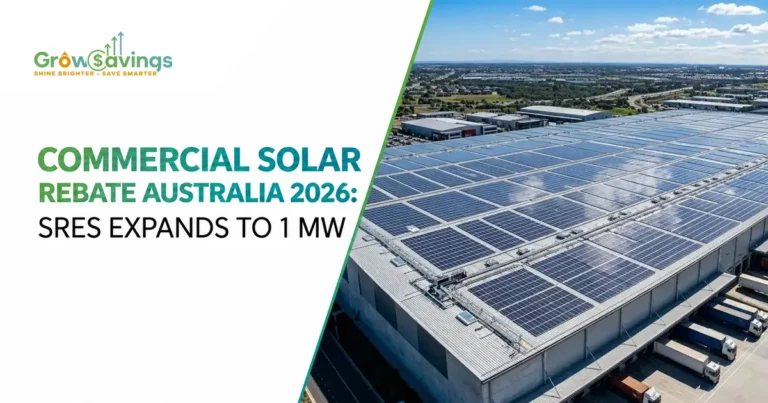
The Commercial Solar Rebate in Australia now supports eligible solar systems up to 1 megawatt (MW) under the expanded Small-scale Renewable Energy Scheme (SRES). Effective 1 October 2026, this change allows larger businesses to access upfront solar incentives through Small-scale Technology Certificates (STCs). Previously, the scheme generally covered solar installations up to 100 kilowatts (kW).
This expansion creates new opportunities for Australian warehouses, factories, farms and commercial facilities to reduce solar installation costs.
However, businesses must understand the new eligibility requirements, certificate calculations and application process before investing.
What Is the Commercial Solar Rebate in Australia?
The Commercial Solar Rebate is a financial incentive that reduces the upfront cost of eligible business solar installations.
The Australian Government provides this support through the Small-scale Renewable Energy Scheme (SRES).
Under this scheme, eligible solar installations generate STCs representing estimated renewable electricity production.
Businesses can sell these certificates or assign them to an authorised agent. In many cases, the certificate value reduces the installation price.
Unlike a traditional cash rebate, the financial benefit depends on certificate eligibility and market value.
What Changed Under the SRES Expansion in 2026?
The Australian Government expanded SRES eligibility from 100kW to 1MW on 1 October 2026.
Previously, larger commercial installations generally relied on Large-scale Generation Certificates (LGCs), which depend on actual electricity generation.
Now, eligible mid-scale installations can access upfront STC incentives.
SRES Eligibility Before and After October 2026
| Feature | Before expansion | From 1 October 2026 |
|---|---|---|
| SRES solar capacity | Up to 100kW | Up to 1MW |
| Systems above 100kW | Generally LGC pathway | STC pathway available |
| Incentive timing | Upfront for eligible small systems | Upfront for eligible mid-scale systems |
| Mid-scale deeming period | Not applicable | Fixed five years |
| Mid-scale STC applications | Not available | Expected mid-to-late November 2026 |
Importantly, mid-scale STC applications are not yet open as of 29 October 2026.
However, eligible systems installed from 1 October can apply once the Clean Energy Regulator opens the application process.
Who Is Eligible for the Commercial Solar Rebate?
The expanded scheme targets larger commercial, industrial, agricultural and community solar installations.
Potential applicants include warehouses, manufacturing facilities, shopping centres, farms and large office buildings.
For mid-scale eligibility, the combined capacity of related solar systems must exceed 100kW without exceeding 1MW.
Installations must also meet applicable technical, accreditation and approval requirements.
Solar panels and inverters must appear on approved equipment lists. Installations must follow relevant Solar Accreditation Australia guidelines.
Furthermore, applicants must provide evidence that applicable planning and approval requirements have been satisfied.
Existing solar systems may also qualify for eligible expansions. However, STCs generally apply only to the additional capacity installed from 1 October 2026.
How Much Can Businesses Save Under the Expanded SRES Scheme?
The expanded Commercial Solar Rebate can substantially reduce upfront installation expenses for eligible businesses.
STC entitlements depend on solar capacity, installation location and the applicable deeming period.
Example: Commercial Solar Rebate for a 500kW System
Consider a Melbourne warehouse installing an eligible 500kW solar system in October 2026.
Using an illustrative solar zone rating of 1.185 and a five-year deeming period:
ILLUSTRATIVE STC CALCULATION
500 X 1.185 X 5 = 2,962.5
Approximately 2,962 STCs after rounding down
Assumed STC value $39
Illustrative incentive value $115,518
This is an indicative calculation, not a guaranteed rebate. Actual entitlements require confirmation using the regulator’s mid-scale calculator.
Certificate prices, system eligibility and applicable rules can change the final benefit. Clean Energy Regulator+1
Why the Five-Year Deeming Period Matters
The expanded SRES provides a fixed five-year deeming period for eligible mid-scale systems installed through 2030.
By comparison, the deeming period for systems up to 100kW decreases annually.
| Installation year | Up to 100kW | Above 100kW to 1MW |
|---|---|---|
| 2026 | 5 years | 5 years |
| 2027 | 4 years | 5 years |
| 2028 | 3 years | 5 years |
| 2029 | 2 years | 5 years |
| 2030 | 1 year | 5 years |
Therefore, eligible larger commercial installations retain five years of deemed generation when installed in 2027, 2028, 2029 or 2030.
How to Apply for the Commercial Solar Rebate in 2026
Businesses should begin with a professional solar feasibility assessment.
The installer should review electricity consumption, roof capacity, system design and grid connection requirements.
Next, businesses must confirm SRES eligibility and obtain any necessary planning or network approvals.
Once installed, the system must satisfy applicable accreditation, equipment and documentation requirements.
Eligible applicants can then create STCs or use an authorised agent when the application process opens.
The Clean Energy Regulator expects mid-scale applications to open in mid-to-late November 2026. Eligible STCs must generally be created within 12 months of installation.
STCs vs LGCs: Which Solar Incentive Is Better for Businesses?
STCs provide a financial benefit based on deemed electricity generation. Meanwhile, LGCs reward actual renewable electricity generation from accredited power stations.
For eligible mid-scale projects, STCs offer an upfront benefit without waiting for years of electricity production.
However, larger installations may benefit from other renewable energy certificate arrangements.
The expanded rules also allow eligible mid-scale projects to consider the Renewable Electricity Guarantee of Origin (REGO) scheme.
Businesses must compare the available pathways carefully because claiming one certificate type can restrict another. Clean Energy Regulator
Frequently Asked Questions
1. What is the new commercial solar rebate limit in Australia?
From 1 October 2026, eligible solar systems above 100kW and up to 1MW can access STCs under the expanded SRES.
2. Can a 500kW solar system qualify for STC rebates?
Yes. A 500kW installation may qualify if it meets capacity, equipment, accreditation, planning and other eligibility requirements.
3. When can businesses apply for the expanded SRES rebate?
Eligible systems installed from 1 October 2026 can apply once applications open, expected in mid-to-late November 2026.
4. Does the five-year deeming period decrease in 2027?
No. Eligible mid-scale solar systems retain a fixed five-year deeming period through 2030.
Conclusion
The Commercial Solar Rebate expansion allows eligible Australian businesses to access upfront STC incentives for solar installations up to 1MW.
This change can reduce initial investment costs and make larger commercial solar projects more financially attractive.
However, businesses should confirm eligibility, grid requirements and certificate entitlements before proceeding.
Planning a commercial solar installation in Australia? Contact Grow Savings Pty Ltd for a personalised solar assessment and quote. Explore suitable commercial solar solutions and available government incentives for your business.