
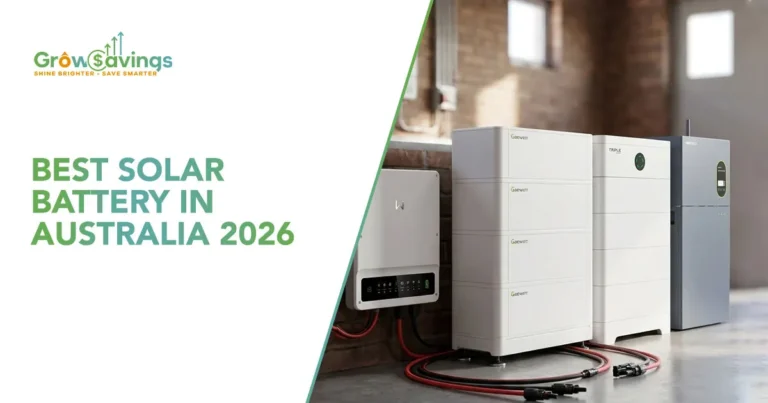
Electricity prices keep rising across Australia. Feed-in tariffs have fallen to as low as 2–5 cents per kilowatt-hour in many states. If you have solar panels, you are probably exporting cheap energy to the grid and then buying it back at expensive peak rates. The solution? A home solar battery. Finding the best solar battery in Australia in 2026 is easier than ever, thanks to more brands, better technology, and a generous federal rebate that slashes upfront costs by around 30%. This guide covers everything you need to know – top brands, real prices, rebate details, and how to choose the right battery for your home.
Why Solar Battery Storage Is Booming in Australia
Australia is one of the world’s leaders in rooftop solar. More than 4.2 million homes have solar panels installed. However, solar panels only generate energy during daylight hours. Without a battery, most of that power gets exported to the grid for very little return.
The case for home battery storage has never been stronger than in 2026. Grid electricity prices have risen more than 20% in some states over recent years. At the same time, the federal government launched the Cheaper Home Batteries Program in July 2025, a $7.2 billion initiative that provides around a 30% discount on eligible battery installations. Australian households, businesses and community organisations can now get a discount of around 30% on the upfront cost of installing a range of small-scale battery systems from 5 kWh to 100 kWh.
The numbers tell the story. Before the program, only one in 40 households had installed batteries. Thanks to the rebate, one in 24 households now has a battery connected to their solar system. That is a dramatic shift in just one year.
A solar battery transforms your solar system from a daytime-only tool into a 24-hour energy solution. Instead of paying 28–35 cents per kWh from the grid at night, you use the energy your panels generated during the day -for free.
How Does a Solar Battery Work?
A solar battery stores the excess electricity your solar panels produce during the day. When the sun goes down, the battery releases that stored energy to power your home. You only draw from the grid when your battery is depleted.
Think of it like a water tank for electricity. Your solar panels fill the tank during the day. You draw from the tank at night. You only pay for water (electricity) when the tank runs dry.
Most modern home batteries use lithium iron phosphate (LiFePO₄ or LFP) chemistry. LFP batteries are safer, last longer, and perform better in Australia’s warm climate compared to older lithium-ion technologies. LFP has become the Australian market standard, so chemistry alone no longer differentiates products.
Batteries are measured in kilowatt-hours (kWh). A 10 kWh battery stores 10 units of electricity. The average Australian household uses between 8 and 15 kWh between sunset and sunrise, so a 10–15 kWh battery suits most homes well.
AC-Coupled vs DC-Coupled: What’s the Difference?
You will often see these two terms when comparing batteries. Here is what they mean in plain language.
DC-coupled batteries connect directly to your solar panels through a shared hybrid inverter. They are slightly more efficient because the energy goes through fewer conversion steps. However, they require a specific compatible inverter -meaning you may need to replace your existing inverter if it is not compatible.
AC-coupled batteries have their own built-in inverter. They work with almost any existing solar system, making them the best choice for retrofitting a battery to an older solar setup. Brands like Enphase, Tesla Powerwall 3, and Alpha ESS use AC coupling, which is why they are popular retrofit options.
If you are installing a brand-new solar and battery system at the same time, DC coupling is often more cost-effective. If you already have solar panels, an AC-coupled battery is usually simpler and cheaper overall.
Best Solar Battery in Australia 2026 – Top Brands Compared
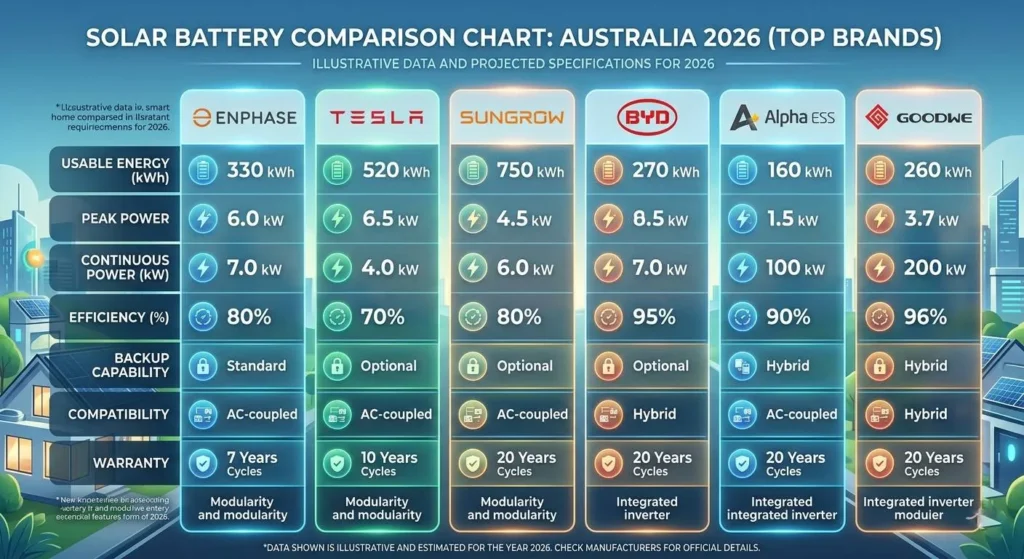
Choosing the best solar battery in Australia depends on your budget, energy usage, and existing solar setup. Below are the top-performing batteries trusted by Australian homeowners and installers in 2026, based on performance, warranty, value, safety, and real-world customer reviews.
1. Enphase IQ Battery 5P -Best Overall
The Enphase IQ Battery 5P takes the top spot based on warranty, tech features, fire safety, and flexibility. It is natively AC-coupled, making it a great retrofit option for almost any existing solar inverter.
Enphase stands out on safety. It holds UL 9540 and 9540A fire safety certifications -one of the strongest safety credentials available for a home battery in Australia. The modular design means you can start small and expand over time as your energy needs grow.
The Enphase app also offers some of the most detailed energy monitoring available, so you always know exactly how your system is performing. The main trade-off is that additional units cannot be stacked physically -each module must be installed separately.
Best for: Homeowners wanting maximum safety, flexibility, and long-term reliability.
2. Tesla Powerwall 3 -Best Premium Pick
The Tesla Powerwall 3 remains one of the most recognised home batteries globally. In Australia, it is widely installed, especially in households already using Tesla solar panels or EVs. Its seamless integration, compact design, and strong outdoor protection make it a favourite for tech-savvy homeowners.
The Powerwall 3 features an IP67 rating, offering excellent protection for outdoor installations. It is also one of the few batteries that includes a full solar inverter built in -meaning if your existing inverter needs replacing anyway, the cost premium over mid-range alternatives shrinks considerably.
The Powerwall 3 has a usable capacity of 13.5 kWh and supports whole-home backup, making it the go-to choice for households wanting both energy savings and protection during blackouts.
Price range (installed): Tesla Powerwall 3 costs approximately $15,000 to $17,000 installed, sitting at around $1,110 to $1,260 per kWh.
Best for: Premium buyers already in the Tesla ecosystem, or anyone wanting the most complete all-in-one solution.
3. Sungrow SBR HV – Best Value for Money
Sungrow is a globally recognised renewable energy brand with over 25 years of experience in solar technology, and it has built a strong reputation in Australia. The SBR HV series consistently tops the value charts in 2026.
The Sungrow SBR HV shines as one of the best solar batteries for households and small businesses. It is scalable from around 10 kWh up to 25 kWh, delivers strong round-trip efficiency, and sits at a competitive price point.
It is DC-coupled, so it requires a Sungrow hybrid inverter. However, for new installations, this makes it a very cost-efficient package. Real Australian customers report electricity bill reductions of 60–70% after installing a Sungrow battery.
Price range (installed): The Sungrow SBR 12.8 kWh system offers the lowest price per kWh in the market, at approximately $664 to $820 per kWh installed.
Best for: Homeowners who want maximum savings without paying a premium price.
4. BYD Battery-Box HVM – Best Modular Battery
BYD is one of the world’s largest battery manufacturers. The BYD Battery-Box HV series features easily stackable batteries in robust alloy housings, allowing you to incrementally increase storage to a substantial 102 kWh. High-voltage units mean the battery does not have to be located right next to the inverter, which helps with meeting Australia’s strict battery location requirements.
This modularity makes BYD ideal for households with growing energy needs -for example, those adding an electric vehicle or a heat pump. BYD batteries are also widely compatible with many popular inverter brands, including Fronius, SolarEdge, and Victron.
Price range (installed): BYD Battery-Box HV systems range from approximately $5,800 to $19,200, or $429 to $480 per kWh.
Best for: Households wanting a scalable, future-proof system that can grow over time.
5. Alpha ESS SMILE Series – Best for Flexibility
Alpha ESS has become a favourite among installers thanks to strong local support, competitive pricing, and dependable hardware. Their systems have also been used in government battery trials in Australia.
The SMILE series is AC-coupled, works as a great retrofit option, and offers flexible sizing from small to large systems. The LFP chemistry delivers strong safety and a long cycle life. Alpha ESS has a well-established service network across Australia, which matters greatly when you need support years after installation.
Best for: Homeowners adding a battery to an existing solar system who want local support and competitive pricing.
6. GoodWe Lynx Home – Best Budget Option
For homeowners who want reliable performance without stretching the budget, GoodWe is the standout choice. GoodWe is one of the largest energy storage manufacturers in the world -the Lynx benefits from that scale in both price and parts availability. Its AC-coupled design means it works with virtually any existing solar inverter, without replacing hardware you have already paid for.
The cheapest battery brand that solar industry experts would comfortably recommend is GoodWe. It has been in the Australian market long enough to build a proven track record, unlike some newer, cheaper imports.
Best for: Budget-conscious buyers adding storage to an existing solar system.
Solar Battery Price in Australia 2026 – What Will It Cost You?
One of the most common questions is: how much does a solar battery cost in Australia? The honest answer is: it depends. However, here are the realistic numbers for 2026.
Typically, solar battery prices range from around $4,000 up to $13,000 or more, depending on how much storage you need. Thanks to the federal battery rebate, solar batteries are now more affordable than ever, with thousands shaved off upfront costs.
For a more specific breakdown:
Most homeowners pay between $7,000 and $15,000, depending on battery size and brand. A 10 kWh system -the most popular size -typically falls in the $9,000 to $13,000 range installed. The cost per usable kWh for most Australian households sits between $800 and $1,300 before state rebates are applied.
Premium brands like Tesla cost more but offer superior warranties and performance. Most batteries now pay for themselves in 6 to 10 years. With a lifespan of 10 to 15 years, a battery can generate significant long-term savings while also protecting you from rising energy prices.
What Affects Solar Battery Installation Cost?
Several factors determine your final quote beyond the battery itself.
Battery capacity: Bigger batteries cost more, but the cost per kWh decreases as you go larger. A 25.6 kWh Sungrow system costs less per kWh than a 12.8 kWh model -because the fixed installation costs are spread across more capacity.
Inverter compatibility: If your existing inverter is not battery-compatible, you will need a new hybrid inverter, adding roughly $2,000 to $4,000 to the project cost. The cost difference can be $1,000 to $3,000, depending on how compatible your existing system is.
Installation complexity: A simple battery installation normally adds at least $3,000 to a quote. A more complicated installation involving longer cable runs, bollards for a garage, or fireproof backing can cost $4,000 or more.
Backup power requirements: Adding whole-home backup capability requires additional hardware and increases the overall price. Essential-load backup (covering lights, fridge, and a few power points) is considerably cheaper than full-home backup.
Location and labour: Installation costs vary between cities. Sydney and Melbourne typically attract higher labour rates than regional areas.
Solar Battery Rebate Australia 2026 – How to Save Thousands
The solar battery rebate landscape in Australia changed dramatically in 2025 and 2026. Understanding the available incentives is essential before getting quotes.
The Federal Cheaper Home Batteries Program
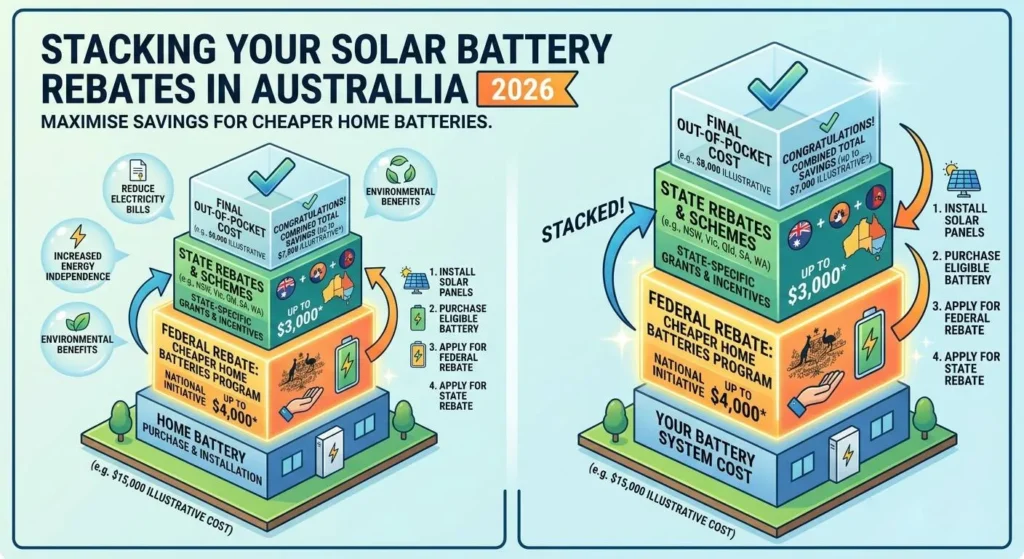
The Australian Government’s $7.2 billion initiative aims to cut the cost of home battery systems by around 30%. The program is delivered through the Small-scale Renewable Energy Scheme (SRES) -the same mechanism used for the solar panel rebate.
The rebate is applied automatically at the point of sale. You do not need to fill out any forms or claim anything afterwards. Your installer applies it directly to your quote -no paperwork, no waiting for cashback. The program is not means-tested, so eligibility depends on your system meeting the technical requirements, not your income.
As of May 2026, the federal solar battery rebate is worth about $252 per usable kWh for most standard home batteries. For a typical 13.5 kWh system, that represents a saving of around $3,400 off the installed cost. Note that the rebate steps down every six months until the program ends in 2030, so installing sooner locks in a higher discount.
To be eligible, your battery must be between 5 kWh and 100 kWh in nominal capacity, listed on the Clean Energy Council’s approved product list, installed by a Solar Accreditation Australia (SAA) accredited installer, and be VPP-capable if connected to the grid.
State-by-State Rebate Snapshot
Beyond the federal program, some states offer additional incentives that can be stacked on top.
Western Australia: WA has an active Residential Battery Scheme that adds a further $1,300 to the federal rebate for eligible households. For most Perth homes, the two rebates combined significantly reduce the payback period.
ACT (Canberra): Canberra locals can access a low-interest loan from $2,000 to $15,000 for home energy improvements, including household batteries. Zero-interest loans are available to eligible concession card holders under the Home Energy Support Program.
New South Wales: From 1 July 2025, the NSW government increased its Virtual Power Plant incentive to up to $1,500 for households connecting their battery to a VPP. This can be stacked on top of the federal rebate.
Victoria: As of 2026, Victoria’s Solar Homes battery rebate has closed. Victorian households can still access the federal program, but there is currently no additional state-level battery rebate.
Queensland and South Australia: Households in these states access the federal rebate. Additional state programs are limited, though Queensland’s high solar irradiance means payback periods are naturally shorter.
Also Read: How Much Is the Solar Battery Rebate in Victoria 2026?
Is It Worth Getting a Solar Battery in Australia?
This is the question most homeowners ask. In 2026, the answer for most Australians is yes -and the economics are more compelling than ever.
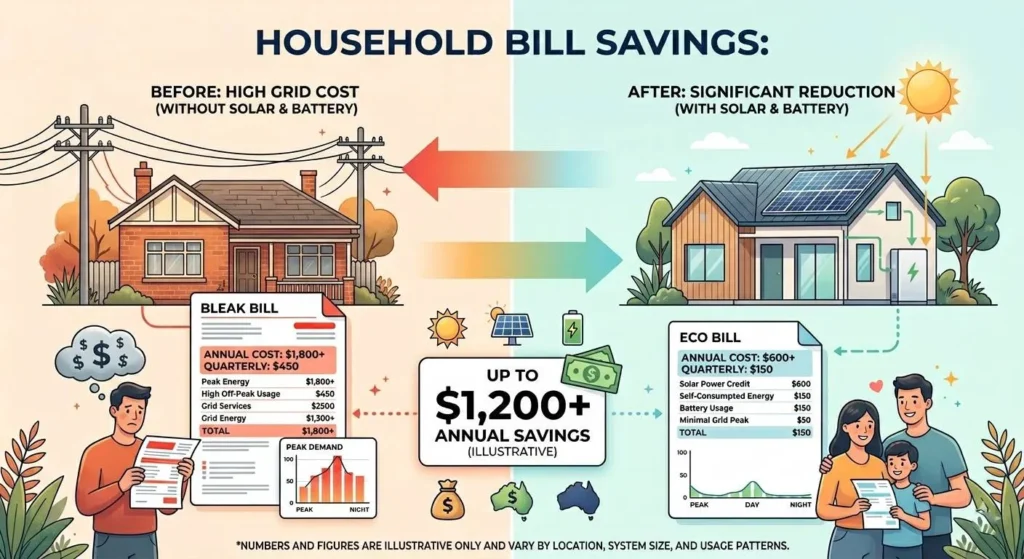
Here is why. Feed-in tariffs have fallen roughly 50% since 2022–23. Most states now pay just 3 to 10 cents per kWh for exported solar. Meanwhile, you buy grid electricity back at 28 to 35 cents per kWh in the evening. Every kWh you store in a battery instead of exporting to the grid saves you the difference -roughly 20 to 30 cents per unit.
With the inclusion of the federal solar battery rebate, solar batteries are now financially viable in many cases. A properly sized battery can reduce your electricity bills by 60 to 80%. Average annual savings for Australian households typically range from $1,200 to $2,000 per year, depending on system size and electricity usage patterns.
Therefore, the payback period for most Australian homes with a quality battery sits at 6 to 10 years. Since most batteries carry a 10-year warranty and operate for 12 to 15 years, the investment makes solid financial sense.
A solar battery also gives you blackout protection. Most modern batteries can keep your essential appliances running during power outages -something that is increasingly valuable as extreme weather events become more frequent across Australia.
However, a battery is not the right choice for every home. If your electricity usage is very low, or you are on a generous feed-in tariff, the payback may be longer. It also pays to maximise your solar panel capacity first, since extra panels typically deliver faster returns than a battery if you are still exporting a small percentage of your solar generation.
How to Choose the Right Solar Battery for Your Home
With more than 30 brands on the Australian market, it is easy to feel overwhelmed. Here is a clear framework to help you decide.
Key Factors to Consider Before Buying
Your nightly energy use: This is the most important factor. Calculate how much electricity you consume between sunset and sunrise. Most Australian households use 8 to 15 kWh overnight, making a 10 to 15 kWh battery the right starting point.
Battery chemistry: LFP chemistry (LiFePO₄) has become the industry preference due to safety, longer cycle life, and better performance in hot climates. Stick to LFP batteries wherever possible.
Round-trip efficiency: This measures how much energy you get back versus what you stored. Look for batteries with 90% or higher round-trip efficiency.
Warranty and cycle life: A longer warranty with a higher cycle count means lower lifetime cost. Most reputable brands offer 10-year warranties with 4,000 or more cycles. Always check whether the warranty covers both calendar years and total throughput.
AC or DC coupling: As explained earlier, AC-coupled batteries work with any existing solar system. DC-coupled systems require a compatible hybrid inverter but are more efficient for new installations.
Modular design: A modular battery, like the BYD HVM or Sungrow SBR, lets you start small and expand later. This is useful if your budget is tight now, but your energy needs may grow -for example, if you plan to buy an electric vehicle.
Brand reputation and local support: The risk with the cheapest budget brands is not that they fail immediately, but that warranty support is harder to access if something goes wrong in year five or six. Choose brands with an established service network in Australia.
Solar Battery Installation – What to Expect
Understanding the installation process helps you plan better and avoid surprises on the day.
Solar battery installation in Australia must be carried out by an accredited professional. DIY electrical work is not permitted. Your installer must be accredited by Solar Accreditation Australia (SAA) -always verify this before signing any contract.
A standard installation typically takes 4 to 8 hours and involves mounting the battery unit, connecting it to your inverter and switchboard, configuring the battery management software, and testing the system. Australian Standards mandate where your battery can be located, and the requirements are stringent, so you may not have many options. Batteries generally need to be in a sheltered, ventilated space away from direct heat sources.
If you want backup power during blackouts, your installer will need to configure a dedicated backup circuit. This requires additional hardware, such as a backup gateway or transfer switch, and it adds to both installation time and cost.
After installation, your battery system will typically connect to a smartphone app that shows real-time energy flows, savings, and battery state. Apps from brands like Tesla, Sungrow, and Enphase are highly rated and provide detailed monitoring.
Finally, check whether your installer offers ongoing monitoring or maintenance services. While modern batteries are largely maintenance-free, having a trusted local contact matters if anything goes wrong years down the track.
Solar Battery Storage and Virtual Power Plants (VPPs)
A Virtual Power Plant (VPP) is a network of home batteries connected together and managed by an energy company. When the electricity grid is under stress -such as during a heatwave -the VPP operator can draw small amounts of power from thousands of home batteries to help stabilise supply.
In exchange, homeowners who join a VPP typically receive financial benefits. Net payments to VPP participants as of early 2026 are typically $36 to $60 per kWh of peak energy discharged, capped at the first 28 kWh of usable capacity. After admin fees, this translates to roughly $720 to $1,500 net per year for a 13 to 20 kWh battery.
Joining a VPP is optional. However, from May 2026, all new batteries receiving the federal rebate must be VPP-capable at installation. This means the hardware must support VPP participation, even if you choose not to enrol. VPP capability is now standard across all major brands.
If you are interested in joining a VPP, compare the terms carefully. Some operators offer higher feed-in tariffs during dispatch events. Others offer fixed annual payments or bill credits. The key question is how much control the operator has over your battery, and what financial compensation you receive in return.
Conclusion
Australia’s solar battery market in 2026 offers more choice, better technology, and stronger financial incentives than at any point in history. The federal rebate alone saves thousands of dollars, and with electricity prices continuing to rise, a well-chosen home battery pays for itself well within its warranty period.
The best solar battery in Australia for your home is the one that matches your energy usage, budget, and long-term goals. For most households, a 10 to 15 kWh LFP battery from a trusted brand like Enphase, Tesla, Sungrow, or BYD delivers the best combination of savings, reliability, and peace of mind.
Always get at least three quotes from SAA-accredited installers. Compare the full system cost -battery, inverter, and installation -not just the battery price. And act sooner rather than later: the federal rebate steps down every six months until 2030, so the savings available today are the highest they will be.
At Grow Savings, we make finding the right solar battery for your Melbourne home simple, transparent, and stress-free. As a Clean Energy Council-certified solar company based in Carrum Downs, Melbourne, we supply and install CEC-approved battery systems from Australia’s most trusted brands – custom-matched to your energy usage, existing solar setup, and budget. Whether you are adding a battery to an existing system or starting fresh with a complete solar-plus-battery installation, our team handles everything from system design and rebate paperwork to installation and ongoing monitoring across Melbourne, Regional Victoria, Adelaide, and the Sunshine Coast. Start with a free energy audit and get an honest, no-obligation recommendation from our CEC-certified team today.
Get Your Free Solar Battery Quote from Grow Savings
Frequently Asked Questions
Which solar battery is best in Australia in 2026?
For most households, the Enphase IQ Battery 5P leads on safety and reliability. The Tesla Powerwall 3 is the best premium all-in-one system. The Sungrow SBR HV offers the best value for money. The right choice depends on your budget, existing solar setup, and energy goals.
How much does a solar battery cost in Australia?
Solar battery prices typically range from around $4,000 to $13,000 or more, depending on how much storage you need. After the federal rebate, a quality 10 kWh system generally costs between $7,000 and $11,000 fully installed.
How does the solar battery rebate work?
The federal Cheaper Home Batteries Program provides around a 30% discount on eligible battery installations. Homeowners do not need to do anything to claim the rebate -installers apply for it and deduct the value from the total system price.
How long do solar batteries last?
Most modern solar batteries last 10 to 15 years. Warranties typically cover 10 years, and well-maintained LFP batteries often continue to perform beyond that. Cycle life (the number of full charge/discharge cycles) is equally important -look for 4,000 cycles or more.
Can a solar battery keep my home running during a blackout?
Yes, most modern home batteries support backup power during outages when paired with a compatible hybrid inverter or backup gateway. Always confirm that your specific battery and inverter combination supports backup mode before purchasing, as not all configurations include this by default.
Is it better to add more solar panels or a battery?
If your solar system is already 6.6 kW or larger and you still run significant evening demand off the grid, a battery is the next best investment. If you have a smaller system and export very little, expanding your solar panels first may offer faster returns.