
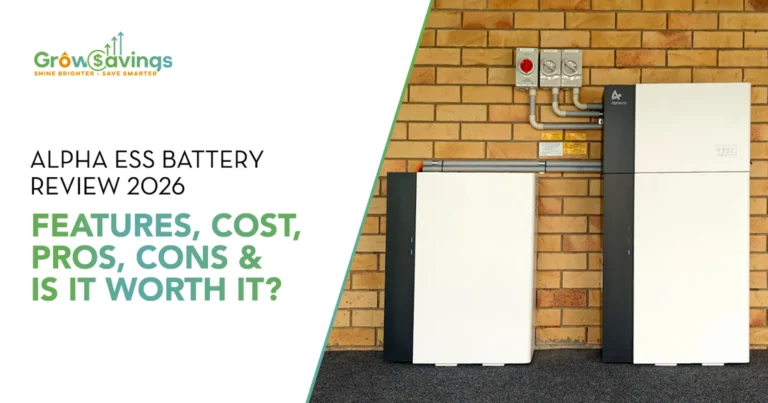
If you are comparing home battery brands, the Alpha ESS battery has probably come up. It is one of the most widely installed batteries in Australia, known for solid performance without Tesla-level pricing.
However, is it actually the right choice for your home? This review covers everything you need to know. We look at real pricing, genuine pros and cons, and how it stacks up against competitors.
Therefore, by the end of this guide, you will know exactly whether the Alpha ESS battery suits your household and budget in 2026.
Alpha ESS Battery Review 2026: Quick Verdict
The Alpha ESS battery is best for budget-conscious households wanting reliable storage without paying premium prices. It offers strong value per kilowatt-hour, a modular design, and a 10-year warranty.
However, it is not the right fit for everyone. Buyers chasing the longest possible warranty or the highest cycle rating may prefer alternatives. Therefore, the right answer depends on your priorities, not just the price tag.
For most Australian households focused on cutting bills and gaining blackout backup, Alpha ESS remains a strong, sensible choice in 2026.
What Is Alpha ESS? Company Background and Australian Presence
Alpha ESS was founded in 2012, with headquarters in Nantong, China. The company has installed more than 10,000 residential and commercial battery systems worldwide, with thousands now operating across Australia.
Importantly, Alpha ESS maintains offices in both Sydney and Adelaide, staffed by Australian-based employees. This local presence matters significantly for warranty support and service requests, particularly compared to brands with no on-the-ground Australian team.
Also worth noting: Alpha ESS has diversified beyond batteries. The company also manufactures EV chargers, reflecting a broader commitment to the Australian energy market rather than a single-product approach.
Alpha ESS Battery Models: Which One Fits Your Home?
Alpha ESS offers several models, but most Australian homes fall into one of two categories.
Alpha ESS SMILE5 Series
The SMILE5 is Alpha ESS’s flagship residential product. It combines a 5 kW hybrid inverter with a modular lithium iron phosphate (LiFePO4) battery stack. Capacity options range from 2.9 kWh up to 80 kWh, depending on how many battery modules you connect.
The most commonly installed configuration is the SMILE5-13.3P, providing 13.3 kWh of usable storage. This model strikes a strong balance between affordability and capacity for the average Australian household.
Alpha ESS SMILE T Series
The Smile T10 (10.1 kWh) and Smile T5 (5.05 kWh) are also widely installed. Both use the same LiFePO4 chemistry. The T10 is the most commonly quoted model among Australian installers, since it balances strong storage capacity with competitive pricing.
Smaller and Larger Options
For smaller households, the SMILE B3 Plus targets units and low-consumption homes wanting the lowest-cost entry point. For larger properties, three-phase homes, and small businesses, the M-Series and StaX commercial range scale up to 50 kWh.
Key Features of the Alpha ESS Battery
Several features explain why Alpha ESS has become one of the fastest-growing battery brands in Australia.
LiFePO4 Battery Chemistry
Every Alpha ESS model uses lithium iron phosphate chemistry. This is the preferred cell type for residential solar batteries in Australia. It handles heat better than standard lithium-ion and carries a longer cycle life at the cell level.
Modular and Expandable Design
The modular structure means you can start with a smaller capacity and add modules later as your budget allows. Therefore, you are not forced into a large upfront purchase if your needs grow over time.
Automatic Backup Switching
The built-in automatic transfer switch (ATS) shifts your home to battery power automatically during a grid outage. No manual intervention is required, which is a genuinely practical feature rather than a marketing gimmick.
AC-Coupling Flexibility
Many Alpha ESS batteries support AC coupling. This allows homeowners to add battery storage to an existing solar system without replacing their current inverter, making it a smart option for retrofit situations.
Smart Monitoring App
Alpha ESS includes a smartphone app for real-time monitoring of generation, storage, and consumption. This helps households track exactly how much grid electricity they are avoiding each day.
Alpha ESS Battery Price in Australia 2026
Pricing is where Alpha ESS genuinely stands out. Based on installer pricing data gathered across NSW, VIC, QLD, SA, and WA in early 2026, here is what Australian homeowners are actually paying.
| Model | Usable Capacity | Installed Price (Before Rebate) | Approx. Price After Rebate |
| SMILE B3 Plus | ~5 kWh | 5,000 – 7,000 | 3,500 – 5,200 |
| SMILE T5 | 5.05 kWh | 7,000 – 9,000 | 5,200 – 6,900 |
| SMILE T10 | 10.1 kWh | 10,000 – 14,000 | 7,000 – 11,000 |
| SMILE5-13.3P | 13.3 kWh | 11,500 – 14,500 | 8,000 – 11,000 |
Prices indicative as of April 2026. The federal Cheaper Home Batteries Program rebate is applied as a point-of-sale discount, currently around $300 to $372 per usable kWh, depending on installation timing.
On average, the installed price for an Alpha ESS battery sits at approximately $1,025 per usable kWh. This places it in the mid-range of the Australian battery market. Therefore, it offers more storage per dollar than premium brands while still delivering genuine reliability.
The SMILE T10 remains the most commonly quoted model, since it offers strong value per usable kWh compared to premium alternatives like the Tesla Powerwall.
Also Read: How Much Is the Solar Battery Rebate in Victoria 2026?
Alpha ESS Battery Warranty: What’s Covered and What to Watch For
Understanding the warranty in detail matters more than most buyers realise, since a battery is charged and discharged daily.
Current Warranty Terms
Alpha ESS battery systems installed from 1 November 2024 carry a 10-year warranty, or until 3,120 kWh of stored energy has been discharged for each kWh of battery capacity, whichever comes first. The warranty guarantees a minimum of 70% capacity retention during that period.
In practical terms, if you fully cycle the battery once per day, the throughput limit translates to approximately 8.5 years of typical use. Therefore, most households will reach the 10-year mark before hitting the cycle limit under normal usage patterns.
How This Compares
The 6,000-cycle rating is honest and competitive for a 10-year warranty. However, it sits below Sungrow’s 10,000-cycle rating, which is genuinely exceptional in the residential market. This is a fair trade-off to understand before purchasing.
A Note on Warranty Claims
Alpha ESS has improved its warranty terms significantly since 2024. However, some Australian customers have reported slow response times during warranty claims, including cases requiring escalation to consumer protection bodies. Therefore, it is worth choosing an experienced local installer who can advocate on your behalf if an issue arises.
Independent testing by ITP Renewables, funded by the Australian Renewable Energy Agency, has also tracked Alpha ESS battery performance over several years. Earlier test models showed some technical issues, though the company has stated significant improvements have been made since those tests were conducted.
Alpha ESS Battery Pros: What Australian Homeowners Like
Based on installer feedback and homeowner reviews, several strengths come up consistently.
Strong value per kilowatt-hour. Alpha ESS offers meaningfully more storage capacity per dollar than premium competitors, making it accessible for budget-conscious households.
Genuine modularity. The ability to start small and expand later is a real practical advantage, not just a marketing point.
Established local presence. With offices in Sydney and Adelaide since 2015, Alpha ESS has a longer Australian track record than many newer entrants, which matters for long-term warranty confidence.
Reliable blackout protection. The automatic transfer switch function works as advertised, switching your home to battery power during outages without manual intervention.
Retrofit-friendly. AC-coupling support makes Alpha ESS one of the easier batteries to add onto an existing solar system without an inverter replacement.
Alpha ESS Battery Cons: What to Consider Before Buying
A fair review also means addressing the genuine drawbacks.
Lower cycle rating than top competitors. At 6,000 cycles, Alpha ESS trails Sungrow’s 10,000-cycle warranty. For very high-usage households cycling the battery more than once daily, this is worth factoring in.
Mixed customer service experiences. Some Australian customers have reported slower-than-expected response times on warranty claims, with a small number escalating complaints to consumer protection authorities. Therefore, installer quality and support responsiveness should factor into your decision.
Manufactured overseas. As a Chinese-manufactured product, some buyers prefer brands with full local manufacturing, even though Alpha ESS maintains Australian offices for sales and support.
Performance varies by installer. Like most battery systems, real-world results depend heavily on correct sizing and installation. A poorly matched system, regardless of brand, will underperform.
Alpha ESS vs Tesla, Sungrow and BYD: How Does It Compare?
Here is how Alpha ESS stacks up against the three most common alternatives Australian buyers consider.
| Battery | Capacity | Approx. Price (After Rebate) | Warranty | Best For |
| Alpha ESS SMILE T10 | 10.1 kWh | 7,000 – 11,000 | 10 years / 6,000 cycles | Best value for budget-conscious buyers |
| Tesla Powerwall 3 | 13.5 kWh | 9,000 – 14,000 | 10 years | Premium all-in-one with built-in inverter |
| Sungrow SBR | 9.6–16 kWh | 6,050 – 8,050 | 10 years / 10,000 cycles | Highest cycle life, strong value |
| BYD Battery-Box HVM | 10.2–16.6 kWh | 5,826 – 8,326 | 10 years | Widest inverter compatibility |
Alpha ESS sits comfortably in the middle of this comparison. It is not the cheapest option on the market, since lesser-known Chinese brands exist at lower price points. However, among brands with a demonstrated multi-year Australian track record, it offers some of the strongest value available.
Sungrow edges ahead on cycle life and is often preferred by installers who stock a single brand across all jobs. Tesla wins on integrated design and brand recognition. BYD offers the broadest inverter compatibility. Alpha ESS, meanwhile, wins on the combination of price, local support, and genuine modularity.
Is the Alpha ESS Battery Worth It in 2026?
Yes, for the right household. Rising electricity prices and falling solar feed-in tariffs are pushing more Australian homeowners toward battery storage. Instead of exporting solar power cheaply during the day, a battery lets you store it and use it later when grid electricity is most expensive.
The Alpha ESS battery is particularly worth considering if you want reliable storage without paying premium pricing, you are retrofitting a battery onto an existing solar system, or you want the flexibility to expand capacity later without committing to a large system upfront.
It may be worth comparing alternatives if you need the absolute highest cycle rating for very heavy daily use, or if local manufacturing is a strict requirement for your decision.
Also, remember that the federal Cheaper Home Batteries Program currently reduces the cost of any eligible battery by roughly $300 to $372 per usable kWh. This rebate, combined with Alpha ESS’s already competitive pricing, makes 2026 a genuinely strong time to invest.
Your Complete Buying Guide: Best Solar Battery in Australia 2026
Conclusion
The Alpha ESS battery earns its reputation as one of the smartest value choices in the Australian battery market. It is not the cheapest, and it is not the most premium, but it consistently delivers reliable storage, genuine modularity, and strong local support at a price that makes battery storage accessible to more Australian households.
At Grow Savings, our CEC-certified Solar team in Carrum Downs, Melbourne helps homeowners across Victoria choose the right battery, whether that is Alpha ESS, Sungrow, BYD, or Tesla, based on your actual energy usage and goals. We assess your existing solar system, your roof, and your budget before recommending the right fit.
Start with a free energy audit and get an honest recommendation tailored to your home.
Book your free battery consultation with Grow Savings today
Frequently Asked Questions
Is the Alpha ESS battery good?
Yes, the Alpha ESS battery is considered a reliable, mid-range option in the Australian market. It uses safe LiFePO4 chemistry, offers a modular design, and carries a 10-year warranty. It is particularly well regarded for value per kilowatt-hour compared to premium brands.
How much does an Alpha ESS battery cost in Australia?
An Alpha ESS battery typically costs between $5,000 and $14,500 installed before rebates, depending on the model and capacity. After the federal Cheaper Home Batteries Program rebate, most households pay approximately $3,500 to $11,000 for a quality system, depending on size.
What is the Alpha ESS battery warranty?
Alpha ESS battery systems installed from November 2024 carry a 10-year warranty, or until 3,120 kWh of stored energy is discharged per kWh of capacity, whichever comes first. This guarantees a minimum of 70% capacity retention. In practical terms, this equates to approximately 6,000 cycles, or 8.5 years if cycled once daily.
How does Alpha ESS compare to Tesla Powerwall?
Alpha ESS is generally more affordable per kilowatt-hour than the Tesla Powerwall 3, though Tesla includes a built-in inverter and offers stronger brand recognition. Alpha ESS suits budget-conscious buyers, while Tesla suits those wanting an integrated, premium all-in-one system.
Is Alpha ESS made in Australia?
No. Alpha ESS batteries are manufactured in China, with the company headquartered in Nantong. However, Alpha ESS maintains offices in Sydney and Adelaide with Australian-based staff for sales, support, and warranty management.
How long does an Alpha ESS battery last?
Most Alpha ESS batteries last approximately 10 to 15 years with normal daily use. The warranty covers 10 years or 6,000 cycles, whichever occurs first, with a guaranteed minimum of 70% capacity retention during that period.
Can Alpha ESS be added to an existing solar system?
Yes. Many Alpha ESS battery models support AC coupling, which allows the battery to be added to an existing rooftop solar system without replacing the current inverter. This makes it a practical option for retrofit installations.
Is the Alpha ESS battery worth it in 2026?
Yes, for households prioritising value, modularity, and reliable blackout protection. With electricity prices rising and feed-in tariffs falling across Australia, storing solar power for later use delivers stronger savings than exporting it. The federal battery rebate further improves the financial case in 2026.