
Choosing the best solar panels in Australia is one of the most important decisions you will make when going solar. The right panel affects how much electricity your system generates, how long it lasts, and how much money you save over 25 years.
However, with over 8,500 panel models from 150 brands listed on the Clean Energy Council’s approved product list, the choice is genuinely overwhelming. Therefore, this guide cuts through the noise.
We compare the top solar panel brands available in Australia in 2026 – across premium, mid-range, and budget tiers – so you can choose with confidence, not confusion.
Why Choosing the Best Solar Panels in Australia Matters More Than You Think
Not all solar panels are created equal. The difference between a quality panel and a cheap one does not just show up on a spec sheet. It shows up on your electricity bill – every single month for the next 25 years.
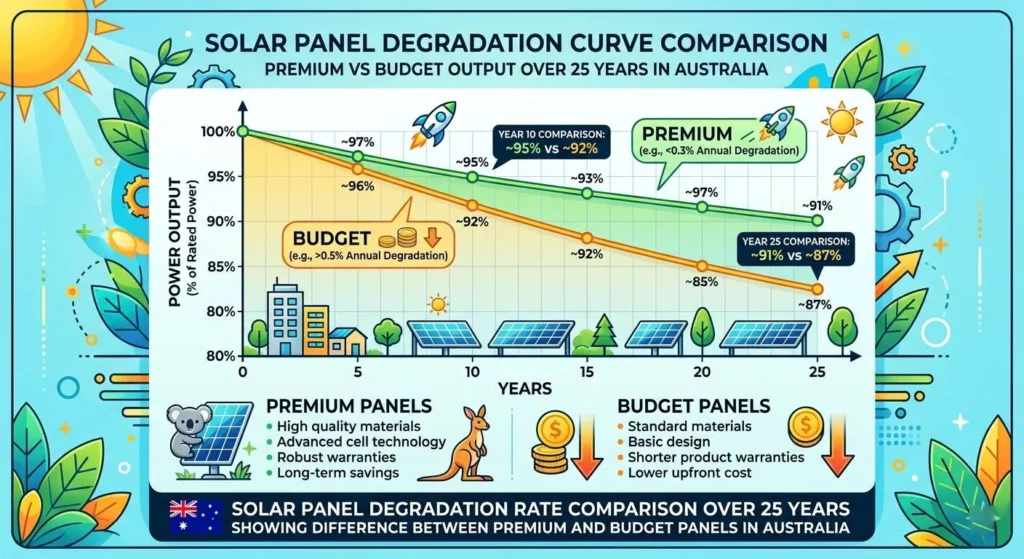
Consider the degradation rate. Premium panels like SunPower degrade at around 0.25% per year. That means they still produce approximately 93.75% of their original output after 25 years. Budget panels typically degrade at 0.55% per year, leaving you with roughly 86.25% after the same period.
That difference in degradation alone adds up to thousands of dollars in lost generation over a system’s lifetime. Therefore, buying on price alone is one of the most expensive decisions a solar customer can make.
Also important: selecting a good panel is only one part of the equation. A quality inverter and a reputable installer are equally critical. Even the best solar panels in Australia will underperform if the inverter is poor or the installation is substandard.
What Makes a Solar Panel “The Best”? Key Factors Explained
Before comparing brands, it helps to understand the five factors that genuinely matter when evaluating any solar panel.
Efficiency
Efficiency measures how much sunlight a panel converts into usable electricity. In 2026, the best residential solar panels in Australia achieve efficiencies between 22% and 24.3%. Higher efficiency means more power from less roof space. However, for homes with ample north-facing roof area, efficiency differences between brands are rarely decisive.
Degradation Rate
Degradation is how much output a panel loses each year. Leading N-type panels in 2026 degrade as little as 0.25 to 0.4% per year. Over 25 years, this difference between brands is significant. Always check the panel’s performance warranty – not just the product warranty – to understand what output is guaranteed at year 25.
Warranty
Two warranties apply to every solar panel. The product warranty covers manufacturing defects and typically ranges from 12 to 40 years, depending on the brand. The performance warranty guarantees a minimum output level – usually 80 to 92% of original output – at the end of the warranty period. A stronger performance warranty reflects the manufacturer’s confidence in the panel’s longevity.
Cell Technology
In 2026, N-type cell technology has become the new standard. N-type panels – including TOPCon and HJT designs – offer better efficiency, lower degradation rates, and superior performance in high temperatures compared to older P-type PERC panels. For new installations in Australia, N-type is the clear recommendation.
CEC Approval and Local Support
Every panel must be on the Clean Energy Council’s approved product list to qualify for government rebates. Also critical: the manufacturer must have a local Australian presence to honour warranty claims. A panel with a 25-year warranty from a company with no Australian office is effectively a 25-year warranty with no practical support.
Related Guide: Solar Rebate Victoria 2026: Complete Guide for Homeowners
N-Type vs P-Type Solar Panels: What Australian Buyers Need to Know in 2026
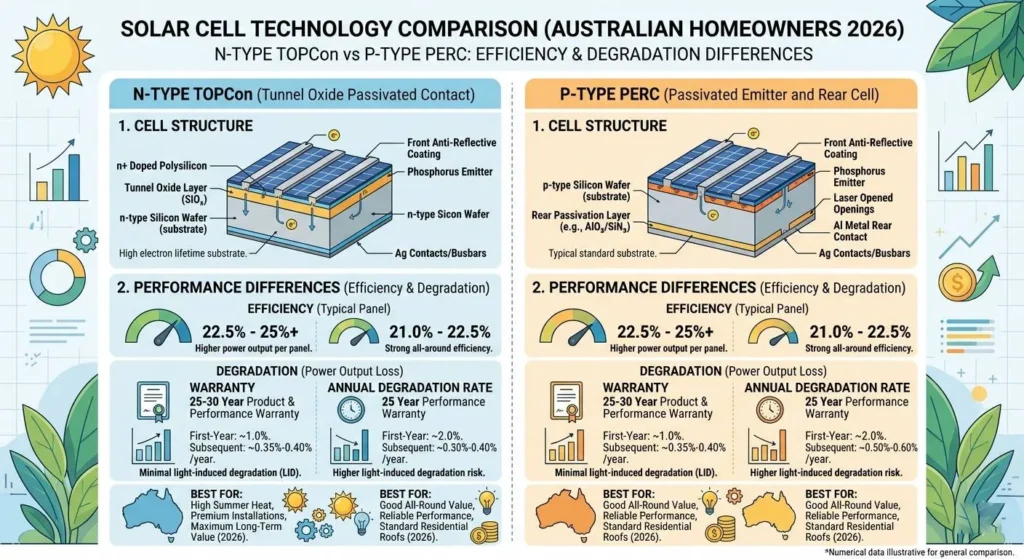
This distinction matters more in 2026 than it did just two years ago.
P-type PERC panels were the residential standard in Australia from roughly 2016 to 2023. They are still widely available at lower price points. However, they suffer from a phenomenon called Light-Induced Degradation (LID), which reduces output in the first months of operation. They also perform less efficiently in high temperatures.
N-type panels – which include TOPCon and Heterojunction (HJT) technologies – do not experience LID. They also have lower temperature coefficients, meaning they lose less output on hot Australian summer days. Most premium and mid-range panels in 2026 use N-type cells, and P-type is being phased out by most leading manufacturers.
For new installations, N-type is the clear recommendation. If a quote includes P-type PERC panels, ask your installer why and whether an N-type alternative is available within a similar budget.
Best Solar Panels in Australia 2026: Top Brands Compared
The following comparison covers the most widely recommended and installed solar panel brands in Australia in 2026, drawn from independent installer surveys, Clean Energy Council approval data, and verified technical specifications.
| Brand | Cell Type | Efficiency | Product Warranty | Performance at 25 yrs | Tier |
| SunPower Maxeon 6 | IBC N-type | Up to 23% | 40 years | 93% | Premium |
| REC Alpha Pure-RX | HJT N-type | Up to 22.6% | 25 years | 92% | Premium |
| Aiko Neostar 2S | ABC N-type | Up to 24.3% | 25 years | 90.6% | Premium |
| Winaico WST-NGX | N-type | 23.3% | 30 years | 88.85% | Mid-range |
| LONGi Hi-MO X6 Max | HPBC N-type | Up to 23.3% | 25 years | 89.4% | Mid-range |
| Trina Vertex S+ | TOPCon N-type | Up to 22% | 25 years | 87.4% | Budget/Mid |
| Jinko Tiger Neo | TOPCon N-type | Up to 22.84% | 25 years | 87.4% | Budget/Mid |
| Canadian Solar HiKu7 | TOPCon N-type | Up to 23.38% | 25 years | 87.4% | Budget/Mid |
Specifications based on publicly available manufacturer data, January to March 2026.
Premium Tier: Best Solar Panels When Only the Top Will Do
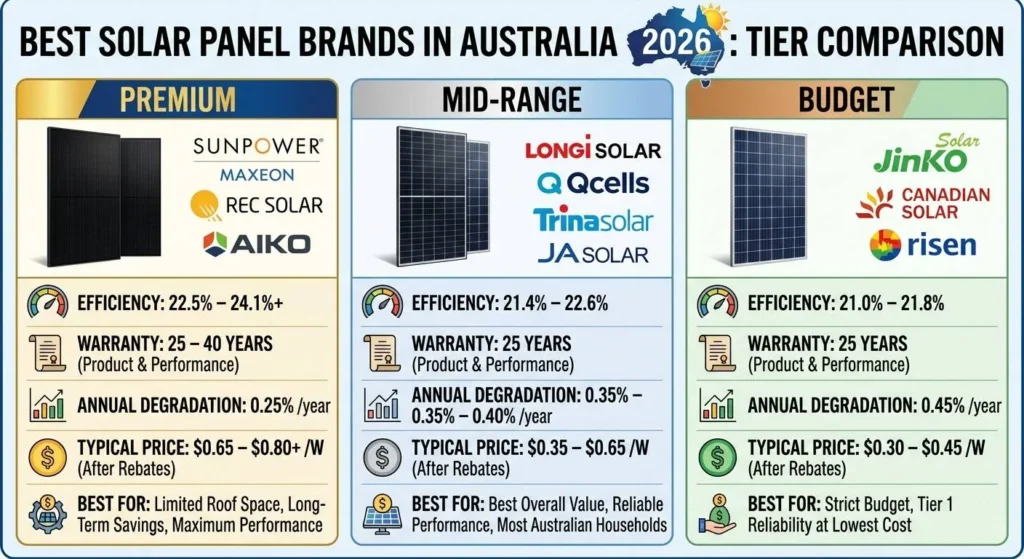
Premium solar panels cost more upfront. However, they offer the highest efficiency, lowest degradation rates, and longest warranties available in Australia. For Melbourne and Victorian homes with limited roof space, or for buyers who want maximum long-term performance without compromise, these brands lead the market.
SunPower Maxeon 6
SunPower Maxeon panels are the gold standard for longevity in the Australian market. Their industry-leading 40-year product warranty is unmatched by any competitor. Also, their IBC cell technology delivers up to 23% efficiency and the lowest degradation rate of any mass-market panel – approximately 0.25% per year. Premium panels like SunPower’s Maxeon series still produce around 93% of their original output after 25 years.
The price premium is real. SunPower panels typically cost $0.50 to $0.61 per watt – approximately 70 to 100% more than budget alternatives. However, for buyers prioritising total lifetime energy generation over upfront cost, SunPower remains the benchmark.
REC Alpha Pure-RX
REC has consistently ranked as the top-rated premium panel among Australian installers for several years. Their Alpha Pure-RX uses HJT (Heterojunction) N-type cell technology, delivering up to 22.6% efficiency and a 92% performance guarantee at year 25 – the second strongest in the market.
REC panels perform particularly well in low-light conditions, which is relevant for Melbourne’s variable weather. Their 25-year product and performance warranty is backed by a well-established Australian support network. REC typically costs $0.40 to $0.55 per watt installed – a meaningful premium over budget panels, but considerably less than SunPower.
Aiko Neostar 2S
Aiko is the standout new entrant in Australian solar in 2025 and 2026. Despite only launching in Australia in early 2024, it claimed first place in an independent survey of 161 Australian installers, with 27% of the vote. That is a remarkable result for a brand less than two years in the market.
The Neostar 2S uses ABC (Advanced Back Contact) N-type technology, achieving up to 24.3% efficiency – the highest of any residential panel in this comparison. Also notable: the 455W Neostar 2S achieves 22.8% efficiency at approximately half the price of an equivalent REC panel.
Therefore, Aiko currently offers one of the strongest value propositions in the premium segment. Competitive pricing with performance specs on par with or exceeding established premium brands makes it a compelling choice for Melbourne homeowners who want top-tier performance without the SunPower price tag.
Also Read: 10kW Solar System Melbourne: Cost, Output and Savings 2026
Mid-Range Tier: Best Solar Panels for Balance of Quality and Value
Mid-range panels sit between budget and premium on price, but offer meaningfully stronger warranties, better efficiency, and stronger local support compared to the budget tier. For most Melbourne households, this tier delivers excellent value.
Winaico WST-NGX
Winaico is a Taiwanese manufacturer with a strong reputation for build quality and durability in Australian conditions. Their WST-NGX achieves 23.3% efficiency and carries a 30-year product warranty – the longest of any mid-range brand in this comparison.
Also important for Melbourne: Winaico panels are well-regarded for performance in variable weather and have a strong track record of warranty support through their Australian distributor. They sit at approximately $0.37 to $0.44 per watt, representing genuine mid-range positioning.
LONGi Hi-MO X6 Max
LONGi is one of the world’s top-three solar manufacturers and has a well-established presence in the Australian market. Their Hi-MO X6 Max uses HPBC N-type technology to achieve up to 23.3% efficiency at one of the most competitive price points in the mid-range tier.
The 475W output per panel is the highest of the mid-range options, which means fewer panels are needed for a given system size. For Melbourne homes with a limited roof area, this is a practical advantage. LONGi’s 25-year product and performance warranty is backed by a large global company with solid local presence in Australia.
Budget Tier: Best Solar Panels for the Cost-Conscious Buyer
Budget does not mean bad. The leading budget-tier brands in 2026 are established Tier 1 manufacturers with global scale, long performance warranties, and CEC-approved product ranges. For Melbourne households on a tighter budget, these brands offer genuine reliability at the lowest price points.
Trina Solar Vertex S+
Trina Solar has dominated the best-value category in independent installer surveys for four consecutive years. Their Vertex S+ uses N-type TOPCon cells to achieve up to 22% efficiency with a 25-year performance warranty.
Budget panels from Trina cost approximately $0.27 to $0.29 per watt – the lowest in this comparison. Also, the Vertex S+ sits in a sweet spot between budget and premium at $0.35 to $0.50 per watt, with N-type technology that outperforms older PERC panels at a similar price point. Trina’s scale and manufacturing quality control are well-established, and their Australian warranty support is reliable.
Jinko Solar Tiger Neo
Jinko Solar is one of the world’s largest solar panel manufacturers and has held second place in best-value installer surveys for four consecutive years. Their Tiger Neo N-type range achieves up to 22.84% efficiency with a 25-year warranty.
The Tiger Neo uses TOPCon N-type cell technology, offering better performance and lower degradation than Jinko’s previous PERC panels. For most Australian homes, the Jinko Tiger Neo or Trina Vertex S+ offer the best balance of performance, warranty, and value at the budget tier.
Performance differences between Jinko, Trina, and LONGi at this price tier are small enough that they rarely determine which system delivers better returns over 25 years. Therefore, the installer’s quality, the inverter choice, and the mounting system are all more significant variables than picking between these three.
Canadian Solar HiKu7
Canadian Solar completes the budget podium, offering up to 23.38% efficiency with a 25-year warranty – the highest efficiency specification of the three leading budget brands. Their HiKu7 series uses TOPCon N-type technology and provides strong performance at competitive pricing.
Solar Panel Efficiency: Does a Higher Number Always Mean Better?
Not always – and this is a common point of confusion for Australian solar buyers.
Efficiency matters most when roof space is limited. A 22% efficient panel produces about 10% more power per square metre than a 20% efficient panel. However, as panel wattages are already adjusted for efficiency in the published output rating, a 440W panel produces 440 watts regardless of whether it achieves that through 21% or 23% efficiency.
Therefore, for Melbourne homes with ample north-facing roof area, chasing the highest efficiency rating is less important than ensuring you are comparing equal wattage panels with strong warranty terms. Efficiency only becomes a decisive factor when your available roof space is genuinely constrained – for example, a narrow terrace home in Melbourne’s inner suburbs where fitting 20 panels rather than 24 changes what system size is achievable.
Solar Panel Warranty: What to Look For and What to Avoid
A warranty is only as good as the company behind it. This is perhaps the most important practical consideration for Australian solar buyers in 2026.
An estimated 1 in 3 solar systems in Australia no longer have active warranty support because the installer or manufacturer has shut down. Therefore, always check that both the panel manufacturer and your installer will be able to honour a warranty claim in year 10 or year 15.
When reviewing a panel warranty, check four things. First, what is the product warranty period? Longer is better – 25 to 40 years indicates genuine confidence in panel longevity. Second, what is the performance guarantee at year 25? Anything above 88% is solid; above 90% is excellent. Third, does the manufacturer have an Australian office or an established Australian distributor? Fourth, what is the warranty claims process? Your installer should be able to describe it clearly.
Also, be cautious of extended warranties offered by third-party insurance products rather than the manufacturer directly. These are often meaningless if the insurer does not operate in Australia or if the policy excludes common failure modes.
Best Solar Panels for Melbourne and Victoria Specifically
Melbourne’s climate creates a few specific considerations that affect panel selection.
Melbourne receives approximately 4.18 to 4.8 peak sun hours per day on an annual average. Winters are cloudier and shorter than in Queensland or Western Australia. Therefore, panels with strong low-light performance – particularly HJT panels like REC’s Alpha range – have a practical advantage in Melbourne conditions.
Temperature coefficients also matter. Melbourne experiences hot summer days above 35 degrees, during which all solar panels lose some output. HJT panels (REC Alpha) typically have the best temperature coefficients of any commercial technology. IBC panels (SunPower) are also very strong on this metric.
However, for most Melbourne households, the practical difference between a premium panel’s temperature coefficient and a mid-range panel’s is small in absolute generation terms. The quality of the installation, the orientation of the roof, and the absence of shading have a far greater impact on real-world Melbourne output than temperature coefficient differences between brands.
For Melbourne homeowners on standard budgets, the mid-range tier – Winaico, LONGi Hi-MO X6, and Aiko Neostar – offers the strongest overall combination of efficiency, warranty, and value for Victorian conditions.
How to Read a Solar Panel Quote and Spot a Bad Deal
When you receive a solar quote, the panel brand is just one line item. Here is how to evaluate the full picture.
Always ask for the specific panel model number – not just the brand. “Jinko 440W” and “Jinko Tiger Neo N-type 440W” are different panels with different warranty terms. The installer should be able to confirm the exact model, its CEC approval status, and the full warranty documentation.
Also, check whether the panels are N-type or P-type. In 2026, any quote specifying P-type PERC panels should prompt a conversation about whether an N-type alternative is available, especially given that P-type panels degrade faster and perform worse in heat.
Compare total system cost per kilowatt – not panel price in isolation. A system with premium Aiko panels and a mediocre inverter may underperform a system with solid Trina panels and a quality Fronius inverter. The inverter is a critical component, and it deserves equal scrutiny.
Finally, verify the installer holds current Solar Accreditation Australia (SAA) accreditation and has a verifiable track record in Melbourne. The best solar panels in Australia are only as good as the installation they are part of.
Complete Price Guide for Homeowners: Solar Panel Cost in Melbourne 2026
Conclusion
Finding the best solar panels in Australia is not just about picking the highest efficiency number from a spec sheet. It is about matching the right panel to your roof, your budget, and your long-term energy goals – and backing that choice with a quality inverter and a reputable CEC-accredited installer.
In 2026, N-type panels dominate every tier of the market. Aiko, REC, and SunPower lead the premium segment. LONGi and Winaico deliver excellent mid-range value. Trina and Jinko remain the most trusted budget options among experienced Australian installers.
At Grow Savings, our CEC-certified team in Carrum Downs, Melbourne, helps homeowners across Victoria choose the right panels, inverter, and system design for their specific property. We only install CEC-approved solar products, and every system is custom-designed around your actual energy usage.
Start with a free energy audit and receive a no-obligation recommendation from our team.
Book your free solar audit with Grow Savings today
Frequently Asked Questions
What are the best solar panels in Australia in 2026?
The best solar panels in Australia in 2026 depend on your budget and goals. For premium performance, SunPower Maxeon 6, REC Alpha Pure-RX, and Aiko Neostar 2S lead the market. For the best balance of quality and value, LONGi Hi-MO X6 Max and Winaico WST-NGX are excellent choices. For budget-conscious buyers, Trina Vertex S+ and Jinko Tiger Neo are the most recommended Tier 1 options among Australian installers.
Which solar panels are the most efficient in Australia in 2026?
The most efficient residential solar panels in Australia in 2026 exceed 23% module efficiency. Aiko Neostar 2S reaches up to 24.3%, which is the highest of any residential panel in this comparison. REC Alpha Pure-RX achieves up to 22.6%, SunPower Maxeon 6 reaches up to 23%, and LONGi Hi-MO X6 Max achieves up to 23.3%.
Are Chinese solar panels reliable in Australia?
Yes. Several Chinese manufacturers including Jinko, Trina, LONGi, and Canadian Solar produce excellent panels used in large-scale commercial projects worldwide. The key is to choose Tier 1 brands that have Australian offices or established local distributors for warranty support. Avoid unbranded or obscure brands with no local presence.
What is N-type solar panel technology?
N-type panels – including TOPCon and HJT designs – use a different silicon structure to P-type PERC panels. They offer higher efficiency, lower degradation rates, and better performance in high temperatures. In 2026, N-type is the recommended technology for new solar installations in Australia. Most leading brands now offer N-type panels across all price tiers.
How long do solar panels last in Australia?
Most quality solar panels carry a 25-year performance warranty guaranteeing at least 80 to 92% of the original output at year 25. In practice, well-installed panels from established manufacturers regularly operate beyond 25 years at functional output levels. SunPower offers a 40-year product warranty – the longest in the Australian market.
What is a Tier 1 solar panel?
A Tier 1 solar panel comes from a manufacturer that has been bankrolled by a Tier 1 bank to finance large-scale solar projects. It is a financial classification, not a quality rating. However, in practice, Tier 1 manufacturers tend to have larger scale, stronger quality control, and more stable business operations than smaller brands. All major brands in this guide are Tier 1.
Which solar panels are best for Melbourne’s climate?
For Melbourne specifically, panels with strong low-light performance and good temperature coefficients are advantageous. REC Alpha Pure-RX (HJT technology), Aiko Neostar, and SunPower Maxeon all perform strongly in Melbourne’s variable weather. For budget-conscious Melbourne buyers, Trina Vertex S+ and Jinko Tiger Neo N-type are reliable, well-supported options suited to Victorian conditions.
Should I choose premium or budget solar panels?
This depends on your roof space, budget, and long-term goals. Premium panels are worth the extra cost when roof space is limited, when you want the longest possible warranty, or when you are prioritising maximum lifetime generation over minimum upfront cost. For most Melbourne households with standard north-facing roof areas, a mid-range panel from Winaico, LONGi, or Aiko offers the strongest overall value proposition.
Disclaimer: Panel specifications are based on publicly available manufacturer data as of March 2026 and are subject to change. Always confirm specifications and warranty terms directly with your installer before purchasing. Grow Savings does not receive any payment from panel manufacturers for recommendations in this guide