
If your electricity bills are consistently high, a 10kW Solar System could be the smartest energy investment you make in 2026. This system size is quickly becoming the preferred choice for large Melbourne households, EV owners, and small businesses across Victoria.
However, it is not the right fit for every property. Therefore, this guide covers everything you need to know – the real cost, how much power it generates in Melbourne’s climate, how much you can save, and what rebates are available right now.
By the end, you will know exactly whether a 10kW Solar System suits your home and budget.
Is a 10kW Solar System Right for Your Melbourne Home?
A 10kW Solar System is a medium-to-large residential installation. It works best for households that use significant electricity – particularly during the day.
You are a strong candidate for this system size if your daily electricity consumption regularly exceeds 25 kWh. Also, if you run ducted reverse-cycle air conditioning, have a swimming pool, charge an electric vehicle, or operate a home-based business, this system is well-matched to your needs.
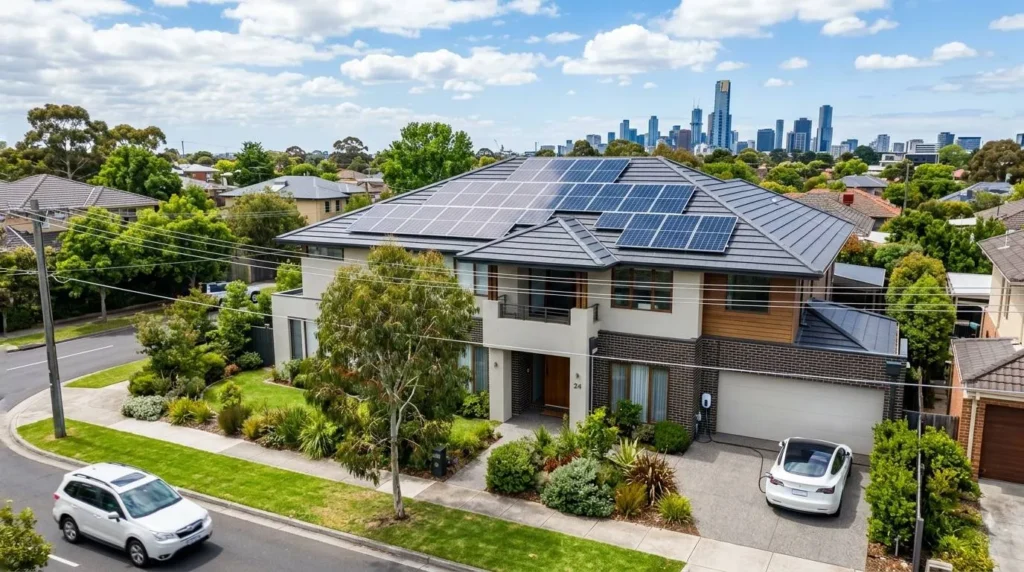
A 10kW solar system is a good-sized system for households wanting to charge electric cars with solar and move towards replacing gas appliances with electric ones.
However, for smaller households using less than 20 kWh per day, a 6.6kW system often delivers a better balance of cost and savings. Therefore, always base your decision on your actual energy usage – not just system size.
What Is a 10kW Solar System and How Does It Work?
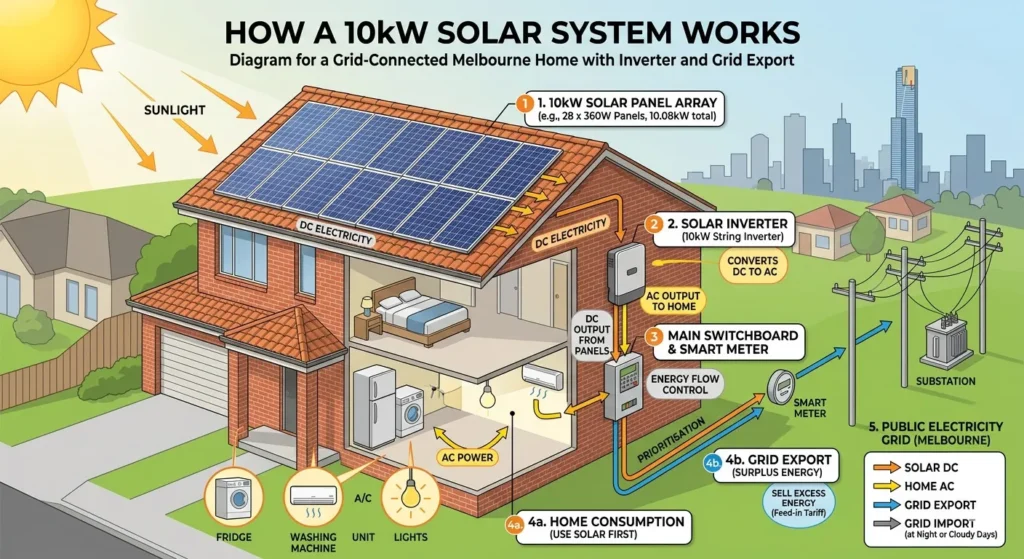
A 10kW solar system refers to a solar panel array with a peak output of 10,000 watts under ideal conditions. In practice, most Melbourne installations pair a 10kW panel array with a matching 10kW inverter or two 5kW inverters in parallel.
The system works in three simple steps. First, the solar panels capture sunlight and convert it into direct current (DC) electricity. Second, the inverter converts that DC power into alternating current (AC) electricity that your home actually uses. Third, any surplus power flows to the grid, earning you a feed-in tariff credit on your electricity bill.
Your home always uses solar power first. The grid only supplies electricity when your system is not generating enough – typically at night or on heavily overcast days.
How Many Solar Panels Does a 10kW Solar System Need?
The number of panels depends on the wattage of the individual panels selected.
Most 10kW systems use 24 to 27 solar panels, depending on panel wattage. That usually means around 45 to 60 square metres of roof space is required.
Here is a quick breakdown based on common panel sizes:
| Panel Wattage | Panels Required | Approx. Roof Space |
| 370W | 27 panels | ~46 m² |
| 415W | 24 panels | ~41 m² |
| 450W | 23 panels | ~39 m² |
For best results, panels should face north on an unshaded roof. However, north-west and north-east facing roofs also perform well in Melbourne. A quality installer will assess your roof’s orientation and pitch before recommending the best layout.
10kW Solar System Cost in Melbourne 2026
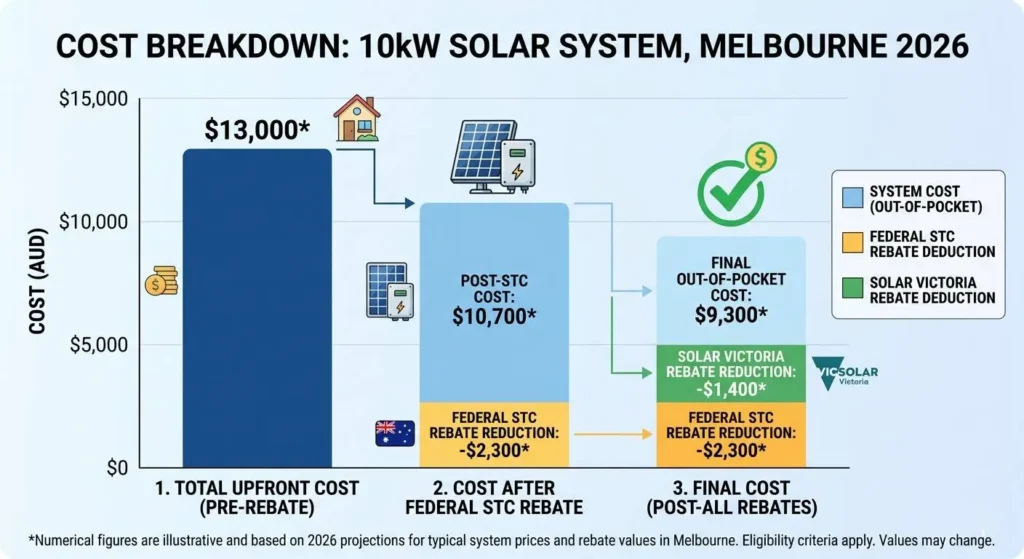
The cost of a 10kW Solar System in Melbourne depends on component quality and installation complexity. Here is a realistic breakdown for 2026.
| Cost Stage | Standard System | Premium System |
| Full installed cost (before rebates) | ~$12,000–$14,000 | ~$15,000–$18,000 |
| Federal STC rebate | ~$3,500–$4,500 | ~$3,500–$4,500 |
| After STC discount | ~$8,500–$10,500 | ~$11,000–$14,500 |
| Solar Victoria rebate (eligible) | $1,400 | $1,400 |
| Net cost (eligible homeowners) | ~$7,100–$9,100 | ~$9,600–$13,100 |
Source: Industry pricing data, March 2026. Individual quotes will vary.
Independent pricing data from March 2026 confirms that a 10kW system in Melbourne costs approximately $8,530 after the STC discount for a standard quality installation. A 10kW system costs around $8,530 after applying the STC discount at the current Melbourne market average.
Therefore, after adding the Solar Victoria rebate, eligible owner-occupiers can access this system size for a net cost well under $9,000 in many cases.
Unsure about solar costs? Read the full guide here: Solar Panel Cost in Melbourne – 2026 Complete Price Guide for Homeowners
What Affects the Price of a 10kW Solar System in Victoria?
Several factors push prices higher or lower from the averages above. Understanding them helps you compare quotes confidently.
Panel Brand and Quality
Budget panels from Tier 1 manufacturers like Jinko and Trina cost less per panel. Premium options from REC, SunPower, or Panasonic cost more but degrade more slowly and carry longer warranties. Over a 25-year system life, premium panels typically generate more total energy.
Inverter Type
A standard string inverter costs less up front. However, a hybrid inverter adds approximately $1,000 to $2,000 but allows you to add battery storage later without replacing the inverter. Also, microinverters or power optimisers suit shaded or complex roofs, though they add $1,000 to $3,000 to the system price.
Roof Complexity
A straightforward single-storey home with a north-facing roof is the simplest – and cheapest – installation scenario. Double-storey homes, tile roofs, or properties requiring long cable runs all add to the labour cost.
Single Phase vs Three Phase Connection
Most standard Melbourne suburban homes are single-phase. A 10kW inverter on a single-phase connection typically requires pre-approval from your Distribution Network Service Provider (DNSP). Three-phase connections allow broader export capacity and simpler approval processes for larger systems.
Government Rebates That Reduce Your 10kW Solar System Cost
Two government incentive programs reduce your upfront cost in 2026.
Federal STC Rebate
The federal Small-scale Renewable Energy Scheme (SRES) provides Small-scale Technology Certificates (STCs) based on your system size and Melbourne’s STC Zone 4 classification. Your installer creates and trades these certificates and applies the value directly as a discount on your invoice.
For a 10kW Melbourne system in 2026, the STC discount is worth approximately $3,500 to $4,500. This rebate steps down each year through to 2030. Therefore, installing sooner means you access a higher discount.
Victorian Solar Homes Program
Eligible owner-occupiers in Victoria can claim an additional $1,400 rebate through the Solar Homes Program. Eligibility requires owner-occupancy, a combined household income under $210,000 per year, a property value under $3 million, and no prior Solar Homes panel rebate at the same address.
An optional interest-free loan of $1,400 – repayable over four years – is also available. Combined with the STC discount, eligible Melbourne homeowners can reduce a standard 10kW system to a net cost of approximately $7,100 to $9,100.
How Much Power Does a 10kW Solar System Produce in Melbourne?
Melbourne receives approximately 4.18 to 4.8 peak sun hours per day on an annual average. That is lower than Brisbane or Perth – but still more than enough to make a 10kW system a strong performer.
Melbourne produces considerably less than sunnier cities – around 22 to 25 kWh per day, annual average for a smaller system – due to lower solar irradiance and more overcast winter days. Scaled to a 10kW system, Melbourne output averages approximately 35 to 42 kWh per day across the year.
Here is how that output changes across seasons:
| Shorter days, more clouds | Daily Output (Approx.) | Notes |
| Summer | 55–65 kWh | Long days, strong sun |
| Autumn/Spring | 38–48 kWh | Variable conditions |
| Winter | 25–32 kWh | Shorter days, more cloud |
| Annual Average | 35–42 kWh | Based on Melbourne climate |
Annual production for a well-installed Melbourne 10kW system sits in the range of 13,000 to 15,000 kWh per year. A 10kW solar system will generate around 11,000 to 14,600 kWh per year.
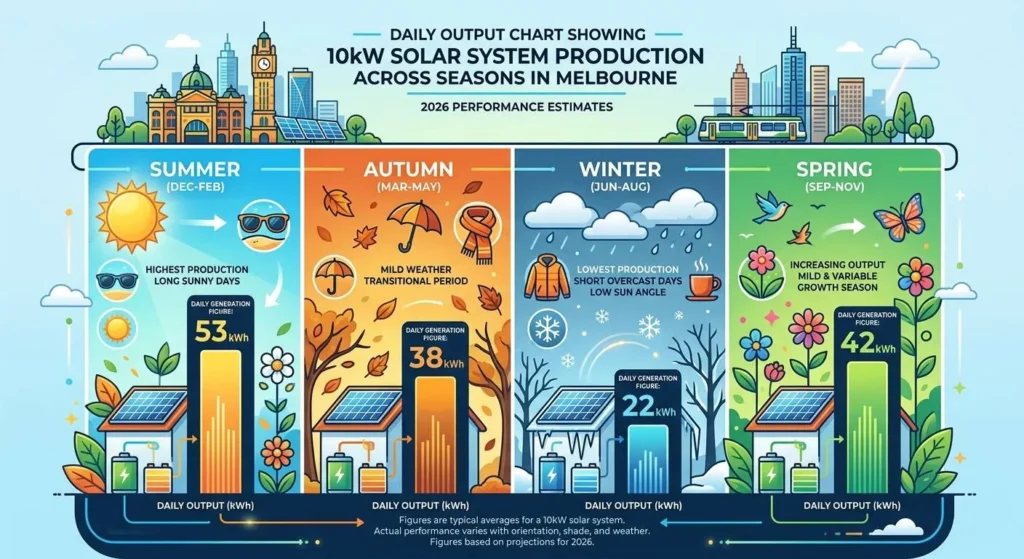
Also note that your roof orientation directly impacts output. North-facing panels at a 20 to 25 degree pitch deliver the highest annual yield. North-west facing panels capture more afternoon generation, which aligns well with after-school and after-work household consumption peaks.
How Much Can a 10kW Solar System Save You Per Year?
Annual savings depend on two key variables: how much of your solar electricity you use directly (self-consumption rate) and your retail electricity import rate.
Using March 2026 pricing data and a 40% self-consumption assumption, a 10kW system delivers approximately $1,943 in annual savings, with a payback period of about 4.4 years.
However, high-usage Melbourne households typically achieve significantly higher self-consumption rates. Here is how savings scale with consumption behaviour:
| Self-Consumption Rate | Est. Annual Savings | Payback Period |
| 30% (lower daytime usage) | ~$1,400–$1,600 | ~5.5–6 years |
| 40% (average household) | ~$1,943 | ~4.4 years |
| 60% (high daytime usage) | ~$2,600–$3,200 | ~3–3.5 years |
| 80%+ (with battery storage) | ~$3,500–$4,400 | ~2.5–3 years |
If you export half of your 10kW system’s electricity generation, you would save approximately $2,805 in the first year based on a 33c per kWh retail rate and 5c per kWh feed-in tariff.
The key takeaway is clear: the more solar electricity you use directly in your home, the higher your savings. Therefore, shift energy-intensive tasks – dishwasher, washing machine, pool pump, EV charging – to daylight hours whenever possible.
Quick Guide: Best Solar System Size for Melbourne Home
Real-World Example: A Melbourne Household on a 10kW System
Consider a family of five in Melbourne’s outer south-east. They have ducted air conditioning, a 50,000-litre pool, and an EV that charges at home. Their daily consumption averages 42 kWh.
Before solar, their quarterly electricity bill was approximately $850. Their annual spend on electricity was around $3,400.
After installing a 10kW solar system on their north-facing roof, their system generates approximately 40 kWh per day on average. They programme their pool pump to run between 10 am and 2 pm and set the dishwasher on a timer for midday. They also charge their EV between 11 am and 3 pm using a smart solar-divert EV charger.
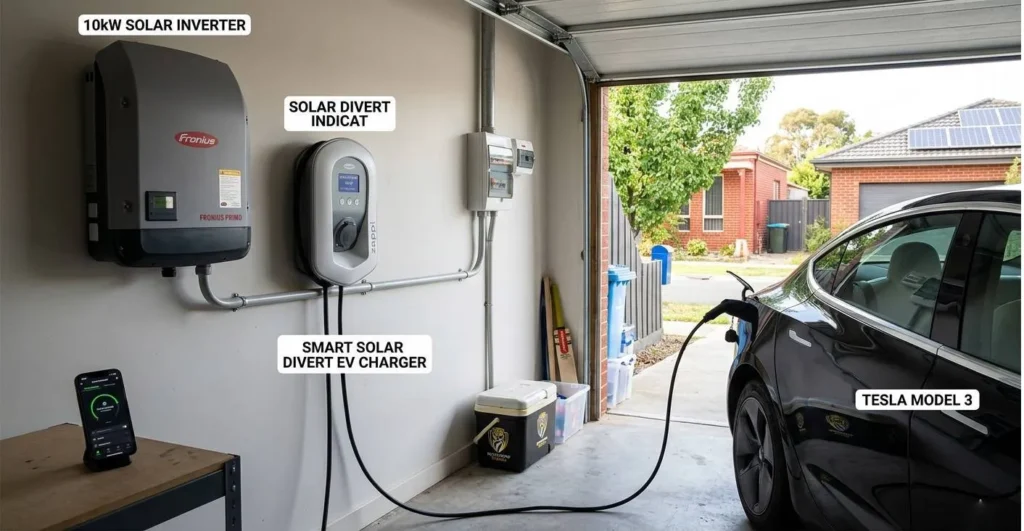
With a 60% self-consumption rate, their annual savings reach approximately $3,000. Their quarterly electricity bill drops from $850 to under $200. Their payback period on a net system cost of $8,500 is approximately three years.
After payback, this household generates electricity at a lifetime cost of around 4 to 5 cents per kWh – compared to the 32 cents per kWh they previously paid to their retailer.
10kW Solar System Payback Period in Melbourne
The payback period for a 10kW solar system in Australia is typically four to six years without battery storage and seven to ten years with battery storage.
For Melbourne specifically, the payback period at standard self-consumption rates is approximately 4.4 years. High-usage households with strong daytime self-consumption can achieve payback in three to three and a half years.
After payback, the system generates effectively free electricity for the remaining 20-plus years of its warranted life. Most quality solar panels carry a 25-year performance warranty guaranteeing at least 80% of the original output at year 25.
Also consider that electricity prices in Victoria are expected to continue rising. Every year after your system is installed, the savings it generates become more valuable in absolute terms. Therefore, the total lifetime savings from a 10kW Melbourne system can comfortably exceed $60,000 to $80,000 over 25 years.
10kW Solar System With Battery: What Does It Cost and Is It Worth It?
A 10kW Solar System generates enough daily surplus to fully charge a 10 to 15 kWh battery on most Melbourne days – including typical winter days. This makes the pairing genuinely practical, not just theoretical.
Cost of Adding Battery Storage
A quality 10 kWh battery system installed in Melbourne costs approximately $10,000 to $12,000 before rebates. After the federal Cheaper Home Batteries Program rebate of approximately $3,110 (before the May 2026 rate reduction), the net cost falls to approximately $6,890 to $8,890.
Popular battery options for a 10kW system in Melbourne include:
| Battery | Capacity | Approx. Net Cost (After Rebate) |
| Tesla Powerwall 3 | 13.5 kWh | ~$10,000–$14,000 |
| BYD Battery-Box HVM | 10.2–16.6 kWh | ~$7,000–$11,000 |
| Sungrow SBR | 9.6–16 kWh | ~$5,500–$8,500 |
| Alpha ESS Smile | 10–13 kWh | ~$5,500–$8,000 |
Prices are net of the federal Cheaper Home Batteries Program rebate, indicative as of April 2026.
Is Battery Storage Worth It?
For households on time-of-use tariffs with significant evening electricity consumption, battery storage genuinely accelerates savings. By storing surplus solar and using it instead of buying grid power at peak rates of 40 to 55 cents per kWh in Victoria, a battery can add $800 to $1,500 in annual savings on top of the solar-only savings.
Also, battery storage provides blackout protection – increasingly relevant for Melbourne’s outer suburbs that experience storm-related outages each summer.
However, the battery payback period is typically longer than for solar alone – approximately seven to ten years. Therefore, the decision to add a battery should factor in lifestyle value, energy independence goals and whether you have a time-of-use tariff – not just the financial payback.
Single Phase vs Three Phase: What Melbourne Homeowners Need to Know
Most standard Melbourne suburban homes are connected to the grid via a single-phase supply. This is the most common configuration and works well for a 10kW solar system. However, there are important export limitations to understand.
Victoria’s five distribution network service providers apply a default 5kW export limit per phase on single-phase connections. Therefore, even with a 10kW system, your grid export at any given moment is capped at 5kW. The remaining capacity benefits your self-consumption – not grid export.
This is normal and expected. For households with high daytime usage, this limitation rarely causes a problem. The 10kW system covers all your daytime load with room to spare, while the inverter simply manages the export cap automatically.
Homes with three-phase power have more flexibility. A 10kW three-phase inverter can export across all three phases – effectively allowing greater export capacity. Also, three-phase connections support larger battery systems and commercial-grade EV chargers more easily.
If your property is on single-phase and you are planning a major electrification project – full heat pump conversion, large EV charger, and 10kW solar – it is worth getting a quote for a three-phase upgrade at the same time. In many Melbourne suburbs, this costs approximately $2,500 to $4,500.
A 10 to 13.5 kWh battery is the most common pairing for a 10kW Melbourne system. This size captures most of the daily surplus generation and powers a typical household through the evening peak. The federal Cheaper Home Batteries Program provides approximately 30% off eligible battery installations.
Conclusion
A 10kW Solar System is one of the most powerful investments a Melbourne homeowner can make in 2026. With a payback period under five years, annual savings of up to $3,200 or more for high-usage households, and access to thousands of dollars in government rebates right now, the numbers speak clearly.
The window to access maximum government incentives is also narrowing. The federal STC rebate steps down each year through to 2030, and the Cheaper Home Batteries Program’s highest rebate rate applies only until May 2026.
At Grow Savings, our CEC-certified team specialises in custom-designed solar installations for Melbourne and Victorian homes. We assess your roof, review your energy bills, and design a system that delivers the best possible return – not just the cheapest quote. Start with a free energy audit and get a no-obligation recommendation tailored to your property.
Book your free solar audit with Grow Savings today
Frequently Asked Questions
How much does a 10kW solar system cost in Melbourne in 2026?
A standard quality 10kW solar system in Melbourne costs approximately $8,530 after the federal STC discount, based on March 2026 pricing data. Eligible owner-occupiers can reduce this by a further $1,400 through the Victorian Solar Homes Program rebate, bringing the net cost to approximately $7,100 to $9,100, depending on system quality.
How much power does a 10kW solar system produce per day in Melbourne?
In Melbourne, a well-installed north-facing 10kW system generates approximately 35 to 42 kWh per day on average across the year. Summer output can reach 55 to 65 kWh per day, while winter output averages 25 to 32 kWh per day. Annual production sits in the range of 13,000 to 15,000 kWh.
How many panels does a 10kW solar system need?
A 10kW solar system typically requires 23 to 27 panels, depending on individual panel wattage. Using modern 415W panels, 24 panels are sufficient. The system requires approximately 40 to 46 square metres of suitable roof space.
What is the payback period for a 10kW solar system in Melbourne?
At a 40% self-consumption rate and current Victorian electricity pricing, the payback period is approximately 4.4 years. High-usage households with stronger daytime consumption can achieve payback in three to three and a half years.
How much will a 10kW solar system save me per year?
At an average self-consumption rate of 40%, annual savings are approximately $1,943 per year. High-usage households with a 60% self-consumption rate can achieve $2,600 to $3,200 per year. Adding battery storage can push annual savings toward $3,500 to $4,400.
What size battery suits a 10kW solar system in Melbourne?
A 10 to 13.5 kWh battery is the most common pairing for a 10kW Melbourne system. This size captures most of the daily surplus generation and powers a typical household through the evening peak. The federal Cheaper Home Batteries Program provides approximately 30% off eligible battery installations.
Can I install a 10kW solar system on single-phase power in Melbourne?
Yes. A 10kW solar system can be installed on a single-phase Melbourne property. However, your grid export will be capped at 5kW by your Distribution Network Service Provider. This is expected and normal – the system’s value for single-phase homes comes primarily from self-consumption of the full 10kW output.
Is a 10kW solar system worth it in Melbourne?
For households using more than 25 kWh per day, yes. The 10kW system offers the fastest payback period of the common residential sizes, the highest total annual savings, and the strongest foundation for adding battery storage and transitioning to full home electrification.
Disclaimer: All pricing and output figures are based on publicly available Melbourne market data as of March 2026 and are indicative only. Individual results will vary based on roof orientation, shading, self-consumption patterns, and retailer tariff. Always obtain at least three quotes from SAA-accredited installers before proceeding.